AI Script Writer for Story Structure: Build a Rock-Solid Outline with Three-Act, Save the Cat, and the Hero’s Journey
Every draft that sags in the middle has the same root cause: a structure that was never mapped before the writing began. An ai script writer closes that gap — it turns your logline into a beat sheet, drops each turning point onto its page, and flags the beats you skipped, so the story is engineered before you type «FADE IN.»

This guide walks the three structural systems every screenwriter should know — the three-act structure, Blake Snyder’s Save the Cat beat sheet, and Joseph Campbell’s Hero’s Journey — plus the sequence method, the midpoint, and the turning points that hold a story together. Then it shows exactly how to use AI to outline and pressure-test each one.
Why Story Structure Is the First Problem an AI Script Writer Solves
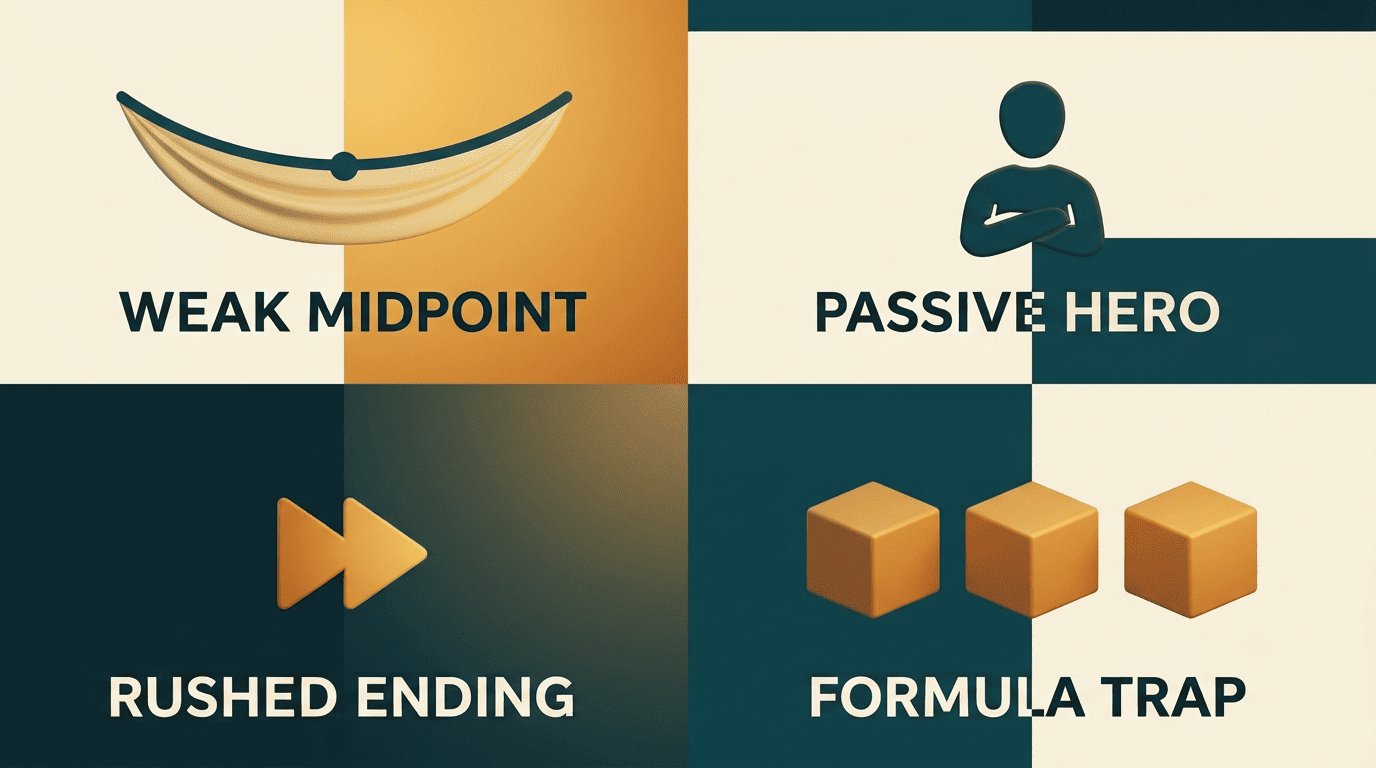
Story structure is not a stylistic preference; it is the load-bearing wall of a screenplay. Think of it as architecture: the three-act structure is the foundation that defines the shape of the building, while frameworks like Save the Cat and the Hero’s Journey are the blueprints for the rooms and staircases inside it. Take the blueprint away and writers hit the same three failures every time:
- A slow or unfocused middle act that drifts without direction.
- A protagonist who reacts to events instead of making choices.
- A climax that feels disconnected from the story’s theme.
Structure fixes all three because it forces cause-and-effect thinking — if something dramatic happens at the midpoint, everything after it has to escalate.
Structure is a blueprint, not a cage
The point of a framework is to guide creativity, not replace it. An outline is only an outline; once you start drafting, the story stays primary. The most common mistake writers make is treating a beat sheet as a formula to fill in mechanically, which drains the voice out of a script. The frameworks below are lenses for seeing your story clearly, not rails your characters are bolted to.
Where an AI script writer fits
An AI scriptwriter is a structural instrument, not a substitute for craft. Most AI script generators follow the same three-stage workflow: input (you supply the concept, characters, and tone), processing (the model organizes intent, structure, and style), and output (a coherent, correctly ordered spine). In practice that means you can feed it a premise and get back a beat-by-beat outline, or paste in a finished draft and have it mapped against a framework so the missing beats are named for you.
The Three-Act Structure: Setup, Confrontation, Resolution
The three-act structure divides a story into a beginning, middle, and end — or, as screenwriter Syd Field labeled them in his 1979 book Screenplay, the Setup, Confrontation, and Resolution. The idea is far older than film: it traces back to Aristotle’s Poetics, the earliest surviving writing manual, which insisted every story have a beginning, middle, and end. Robert McKee reinforced the model for modern screenwriters in his 1997 book Story, and nearly every other framework accepts it as a base layer.
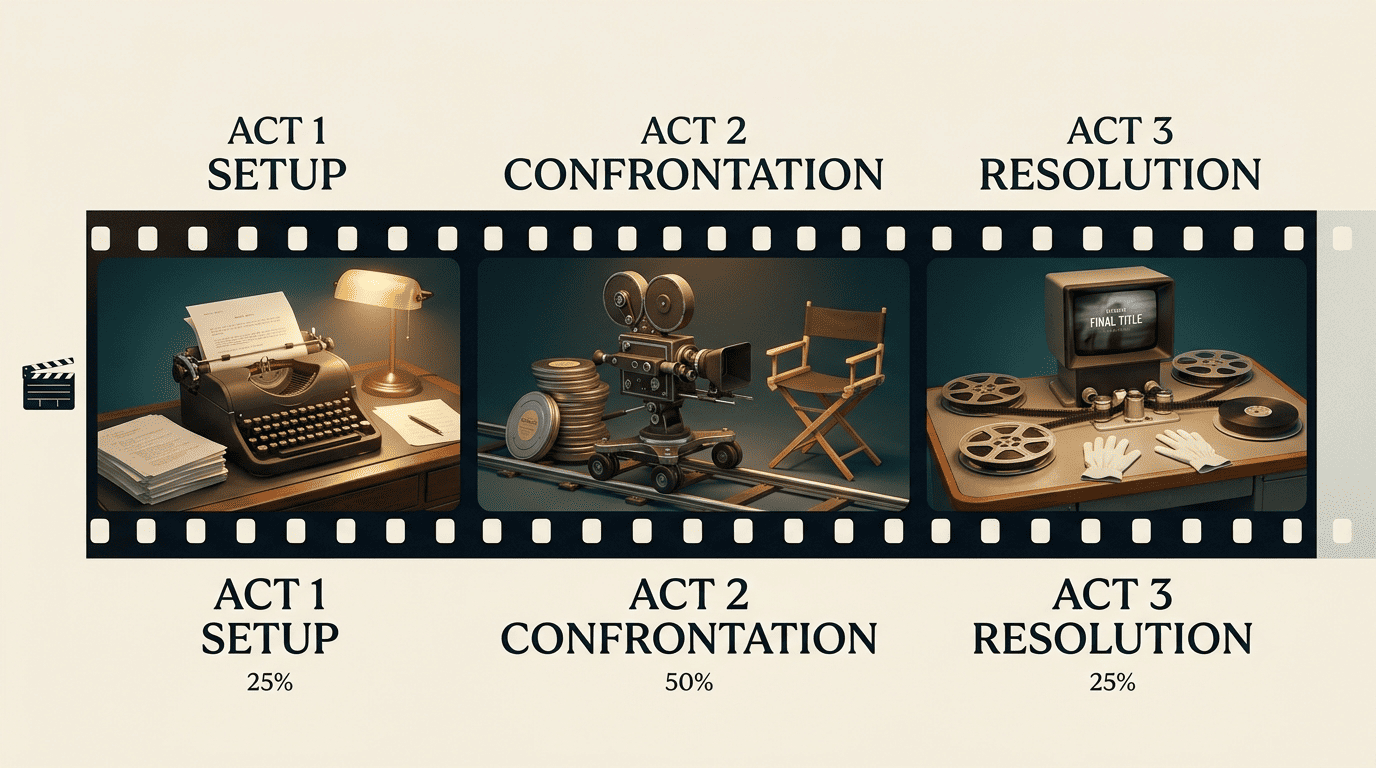
Each act does a specific job. Act One sets up the world, the characters, and the goal, along with the obstacles blocking it. Act Two raises the stakes and escalates the conflict. Act Three resolves the story with either the achievement of the goal or a failure.
Page timing you can hold an AI to
The three acts follow rough proportions that give an AI script writer concrete targets to hit instead of vague «somewhere in the middle» placement.
| Act | Function | Share of runtime | Screenplay pages (110-page script) |
|---|---|---|---|
| Act One | Setup | ~25% | pages 1–25/30 |
| Act Two | Confrontation | ~50% | pages 25/30–85 |
| Act Three | Resolution | ~25% | pages 85–110 |
In a 120-minute film, that is roughly 30 / 60 / 30 minutes. The first act typically ends around page 25–30, at the point of no return that breaks the story into Act Two. When you prompt an AI script generator with these proportions, it can slot your inciting incident and act breaks onto specific pages rather than leaving them to drift.
Save the Cat: Blake Snyder’s 15-Beat Sheet
Save the Cat is a plotting method from Hollywood screenwriter Blake Snyder, whose 2005 book codified an evolution of the three-act structure into 15 beats, each pinned to a page in a standard 110-page screenplay. Snyder built it specifically to solve the second-act problem — the vast, unstructured stretch where so many scripts drown.
Like a swimmer in a vast ocean, there was a lot of open water between those two Act Breaks. And a lot of empty script space in which to get lost, panic, and drown. I needed more islands, shorter swims.
Blake Snyder, Save the Cat!
Those «islands» are the 15 beats. Each one is meant to be describable in a sentence or two — if you cannot fill in the blank that briefly, Snyder argued, you do not have a beat yet.
The 15 beats, page by page
| # | Beat | Page(s) |
|---|---|---|
| 1 | Opening Image | 1 |
| 2 | Theme Stated | 5 |
| 3 | Set-Up | 1–10 |
| 4 | Catalyst | 12 |
| 5 | Debate | 12–25 |
| 6 | Break Into Two | 25 |
| 7 | B Story | 30 |
| 8 | Fun and Games | 30–55 |
| 9 | Midpoint | 55 |
| 10 | Bad Guys Close In | 55–75 |
| 11 | All Is Lost | 75 |
| 12 | Dark Night of the Soul | 75–85 |
| 13 | Break Into Three | 85 |
| 14 | Finale | 85–110 |
| 15 | Final Image | 110 |
The beat sheet has since been adapted for novelists as equivalent percentages of a book’s length, which is why the same 15 beats show up in fiction craft guides. An AI script writer can generate a first-pass Save the Cat sheet from a single logline, then check whether your draft actually lands each beat near its target page.
The Hero’s Journey: Campbell’s Monomyth and Vogler’s 12 Stages
If Save the Cat is about pacing, the Hero’s Journey is about transformation. Based on the work of mythologist Joseph Campbell, it identifies a recurring narrative pattern found in myths across cultures — what Campbell called the monomyth.
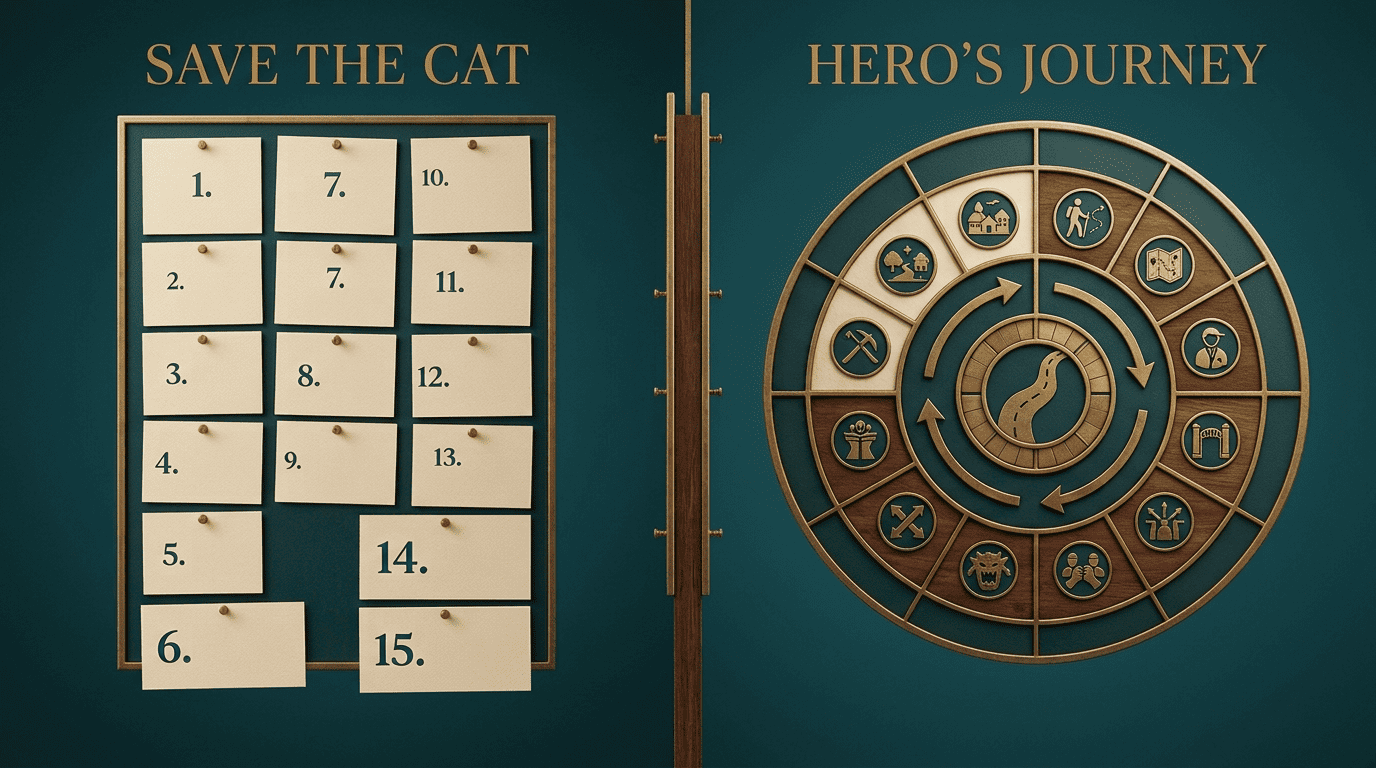
Campbell mapped 17 stages in his 1949 book The Hero with a Thousand Faces, grouping them into Separation, Initiation, and Return. Disney story consultant Christopher Vogler later distilled them into 12 screenwriter-friendly beats in his book The Writer’s Journey:
- Ordinary World
- Call to Adventure
- Refusal of the Call
- Meeting the Mentor
- Crossing the Threshold
- Tests, Allies, and Enemies
- Approach to the Inmost Cave
- Ordeal
- Reward (Seizing the Sword)
- The Road Back
- Resurrection
- Return with the Elixir
Character, not page count
Where Save the Cat governs timing, the Hero’s Journey governs the protagonist’s psychological arc. It does not tell you what page the Ordeal lands on; it tells you the hero must go through something that changes them, and you decide where that falls. That flexibility is why the structure fits fantasy, adventure, and epics so naturally — Star Wars is the textbook example — and why the same shape reads as satisfying whether the «cave» is a literal dragon’s lair or a character’s own psyche. Ask an AI scriptwriter to draft your story through the 12 stages when your priority is a character who leaves home, is tested, and returns transformed.
Mapping the Frameworks: They Describe the Same Story
Here is the part most beginners miss: these systems are not rivals. Save the Cat gives you a linear beat sheet with page numbers, while the Hero’s Journey gives you a mythic cycle — and if you lay one over the other, the same moments line up.
| Save the Cat beat | Hero’s Journey stage | Narrative function |
|---|---|---|
| Opening Image / Set-Up | Ordinary World | Establish the hero’s normal life |
| Catalyst | Call to Adventure | The event that starts the story |
| Debate | Refusal of the Call | The hero hesitates |
| Break Into Two | Crossing the Threshold | The hero enters a new world |
| Fun and Games | Tests, Allies, Enemies | Explore the premise |
| Midpoint | Approach to the Inmost Cave | Stakes escalate |
| All Is Lost | Ordeal | Major crisis |
| Break Into Three | Reward | Insight is gained |
| Finale | Resurrection | Final confrontation |
| Final Image | Return with the Elixir | The transformed hero |
The difference is emphasis, not story: one is a schedule for emotion, the other is a psychology. That is why many professionals use both — Save the Cat to place the midpoint and the all-is-lost moment, the Hero’s Journey to define what the protagonist has to learn or sacrifice. When you are stuck in Act Two, the beat sheet might say you need a «Bad Guys Close In» sequence while the journey says the hero has not yet paid a real price. Both notes can be right at once. An AI script writer that supports multiple templates can relabel the same outline as beats, acts, or stages without rewriting a word of the story.
The Sequence Method and Other Alternatives
The three headline frameworks are not the only maps available. Two more approaches matter, and a handful of alternatives are worth knowing when the standard shapes do not fit.
The sequence method
The sequence approach breaks a feature into roughly eight sequences of about 10–15 minutes each, and every sequence is a self-contained mini-story with its own goal, rising tension, and turning point. The technique dates to the silent era, when films were distributed on physical reels of roughly that length, and it survives because it gives Act Two internal structure — precisely the stretch where scripts sag. Instead of one daunting 60-page middle, you have four or five smaller stories to solve.
Story Circle, Seven-Point, and the Fichtean Curve
Other frameworks trade detail for flexibility, each tuned to a different kind of story:
- Dan Harmon’s Story Circle simplifies the Hero’s Journey into eight steps — You, Need, Go, Search, Find, Take, Return, Change — and its brevity makes it a favorite for television.
- The Seven-Point Story Structure highlights only the seven most important turning points, offering a clear spine without a long list of beats.
- The Fichtean Curve drops the neat act divisions entirely and strings together escalating crises, which suits thrillers and suspense.
Story expert K.M. Weiland offers another useful lens, subdividing the three acts into eight structural beats — the Hook, Inciting Event, First Plot Point, First Pinch Point, Midpoint, Second Pinch Point, Third Plot Point, and Climax. Exploring several frameworks is itself a craft skill: it keeps your storytelling from defaulting to a single formula.
Midpoint and Turning Points: The Load-Bearing Beats
Whatever framework you choose, a few beats carry more weight than the rest. Get them right and the structure holds; get them wrong and no amount of good dialogue will save the middle.
The midpoint
The midpoint sits around the 50% mark — page 55 of 110 in Save the Cat — and it is the beat that redirects everything. Typically it takes the form of a false victory or false defeat: the hero thinks they have things figured out, and then the rug is pulled out from under them. A weak or missing midpoint is one of the most common structural failures, because without that pivot the second act simply repeats itself until the audience checks out.
Plot points and pinch points
Around the midpoint sit the turning points that anchor Act Two. The First Plot Point is the break into Act Two — the point of no return where the characters cross a barrier they cannot walk back. The First and Second Pinch Points fall roughly a quarter and three-quarters of the way through Act Two, and usually apply pressure from the antagonist. The Third Plot Point is the break into Act Three, which launches the highest-stakes stretch of the story. Prompt an AI script generator to locate each of these in your draft; if it cannot find your midpoint or your pinch points, neither can your audience.
How to Use an AI Script Writer to Outline and Pressure-Test Structure
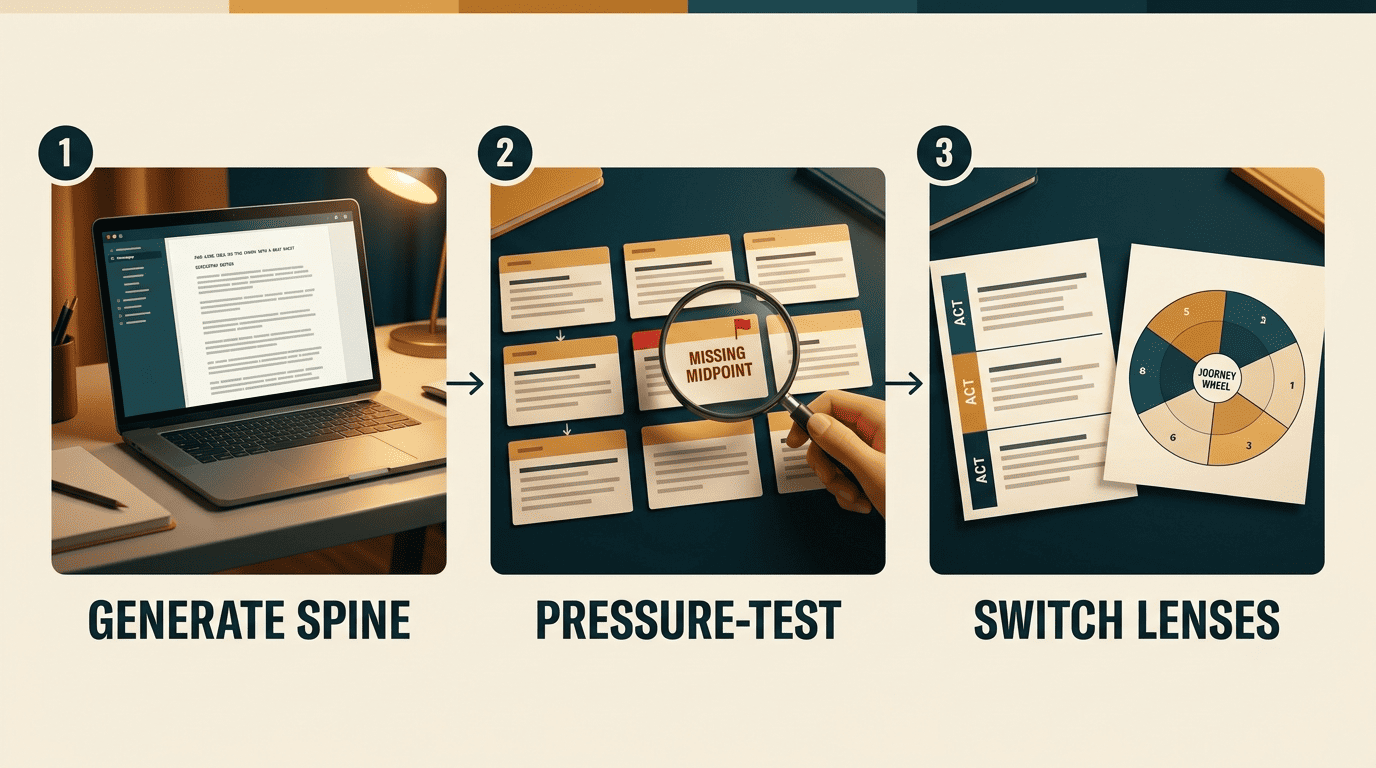
Knowing the frameworks is half the job. The other half is applying them fast, and this is where an AI script generator earns its place in the workflow. Use it in three passes:
- Generate the spine. Prompt with your logline, genre, protagonist’s flaw, and chosen framework — for example, «Give me a Save the Cat beat sheet for a 110-page thriller about a burned-out air-traffic controller.» The AI returns each beat with a page target you can build from.
- Pressure-test the draft. Paste your outline or scenes back and ask the AI to map them onto the framework and name every missing or mislocated beat. The diagnostic questions are the ones Save the Cat was designed to answer: Where is my midpoint? Is the B Story reinforcing the theme? Is my protagonist choosing or reacting?
- Switch lenses. Re-run the same story through a second framework — the Hero’s Journey for character, the sequence method for Act Two — and reconcile the notes. Both readings can be true simultaneously, and the overlap is where the real fixes live.
The throughline is control. The AI handles the structural bookkeeping — page counts, beat placement, coverage checks — while you keep authority over voice, character, and surprise. That division of labor is what lets a writer move from a blank page to a defensible outline in an afternoon.
Common Structure Mistakes AI Helps You Catch
Even writers who know the frameworks fall into the same traps. An AI scriptwriter is useful precisely because it flags them without ego.
| Mistake | What it looks like | AI prompt that surfaces it |
|---|---|---|
| Structure as formula | Scenes feel mechanical, beats forced | «Which beats feel contrived rather than earned?» |
| Weak midpoint | Act Two repeats without a pivot | «Does my midpoint shift the story’s direction?» |
| Passive protagonist | The hero reacts, never decides | «Where does my protagonist make an active choice?» |
| Rushed ending | External conflict resolved, arc unfinished | «Is the internal arc resolved alongside the plot?» |
The fix in every case is the same principle the best screenwriting teachers repeat: structure guides creativity, it does not replace it. Use the beat sheet to catch the problem, then trust the story to solve it.