
AI Script Writer for Loglines: The Formula That Sharpens Your One-Sentence Pitch
A logline is your screenplay’s one- or two-sentence handshake with a producer, and getting it right is the single most valuable thing you can do before writing a first draft. An ai script writer turns a fuzzy premise into a tight, testable hook in seconds — then helps you audit that hook against the rules the industry actually reads for.

This guide breaks down the logline formula (protagonist + goal + conflict + stakes), separates the one-line synopsis from the one-page synopsis and the treatment, and flags the mistakes that get scripts rejected before page one. You will also see exactly where AI speeds up the work and where a human still has to make the call.
What a Logline Is (and Why Every Script Starts With One)
A logline is the script’s core conflict summed up in one or two sentences. It hooks the reader and describes the central conflict of the story without ever giving away the ending. Studios generally want 25 to 35 words, while screenwriting tools like Squibler argue the essence of any script should compress to roughly 20 to 25 words.
Logline, defined
Think of the logline as the elevator pitch for your screenplay: the golden ticket that makes a producer pick up your script instead of the hundred others on the pile. As the standard logline definition puts it, it is a brief summary that states a story’s central conflict — and craft guides such as StudioBinder stress that it deliberately withholds the resolution so the reader has to read on.
A logline is not a tagline and not a synopsis. It is a summary of what the story is, phrased to sell.
Why the logline comes first
The logline carries the foundational DNA the whole movie is built on: the struggle between the major characters and the essence of what is at stake. If you can nail that one sentence before you start writing, you catch structural problems at the concept stage and save yourself months of rewrites.
That is why experienced writers refuse to open a blank script page without a logline in hand. If the one sentence is unclear, the three hundred pages that follow will be unclear too.
The Logline Formula: Protagonist + Goal + Conflict + Stakes
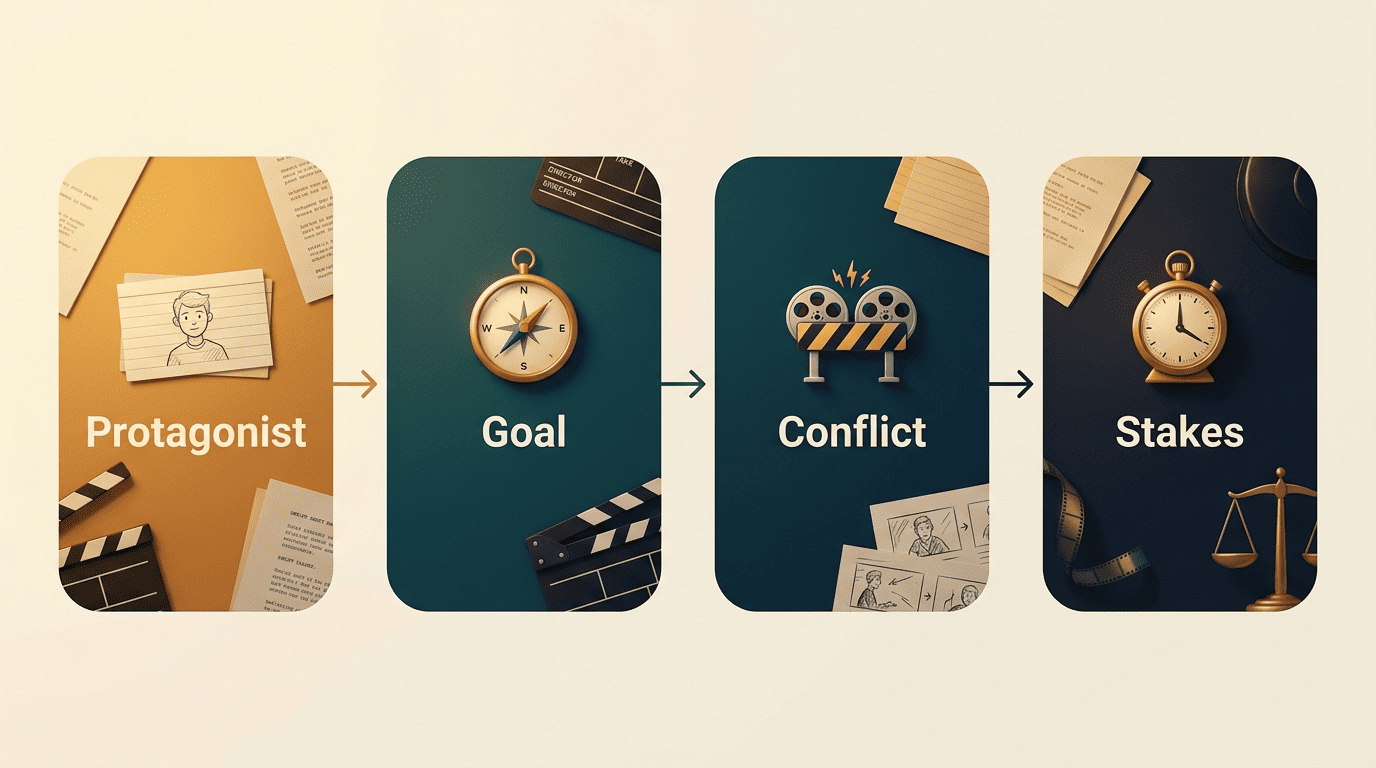
Most great loglines share the same skeleton. You only need four ingredients — a main character, an inciting incident, a central conflict with an antagonist, and clear stakes — arranged into one hooky sentence. A common template reads: When the inciting incident happens, the protagonist decides to take action against the antagonist.
The four ingredients
Protagonist. Describe the character by a defining role or two conflicting adjectives, not by name. «A shy Silicon Valley engineer» tells a reader more than a proper noun ever could.
Goal. State a specific, testable objective. «A man sets out to build a robot» is too broad; «a man sets out to build a robot to win a competition» gives the reader a finish line to visualize.
Conflict and antagonist. Name the opposing force. It can be a person, an institution, or an internal struggle — but the reader needs to feel the pressure the protagonist is under.
Stakes. Answer the question «or else what?» High stakes create tension. They can be literal (a bomb, the end of the world) or figurative (a ruined life), but they must be present.
| Ingredient | What it answers | Weak version | Strong version |
|---|---|---|---|
| Protagonist | Who is this about? | «A man» | «A listless, alienated teenager» |
| Goal | What do they want? | «To be happy» | «To help his friend win the class presidency» |
| Conflict | Who or what opposes them? | «Life is hard» | «A brutal Mississippi plantation owner» |
| Stakes | What is lost if they fail? | «Things get worse» | «The galaxy falls to the Empire» |
Worked example
Watch the formula snap into place on Raiders of the Lost Ark: «In 1936, archaeologist and adventurer Indiana Jones [protagonist] is hired to locate the ancient Ark of the Covenant before the Nazis [conflict with antagonist] and stop them from becoming the most powerful army the world has ever known [stakes].» Every leg of the triangle is doing work.
Now watch stakes get concrete in Speed: «A young police officer must prevent a bomb exploding aboard a city bus by keeping its speed above 50 mph.» The detail — 50 mph — is what makes the peril visual instead of vague.
All drama is conflict. Without conflict, you have no action; without action, you have no character; without character, you have no story; and without story, you have no screenplay.
Syd Field, screenwriting author
Length and format
Keep it to one sentence whenever you can. The rough consensus: under 30 words for a query letter, 25 to 35 words for studio submissions, and up to 50 words for some festival forms. Write in active voice and describe the character by role, not name.
Logline vs One-Line vs One-Page Synopsis vs Treatment
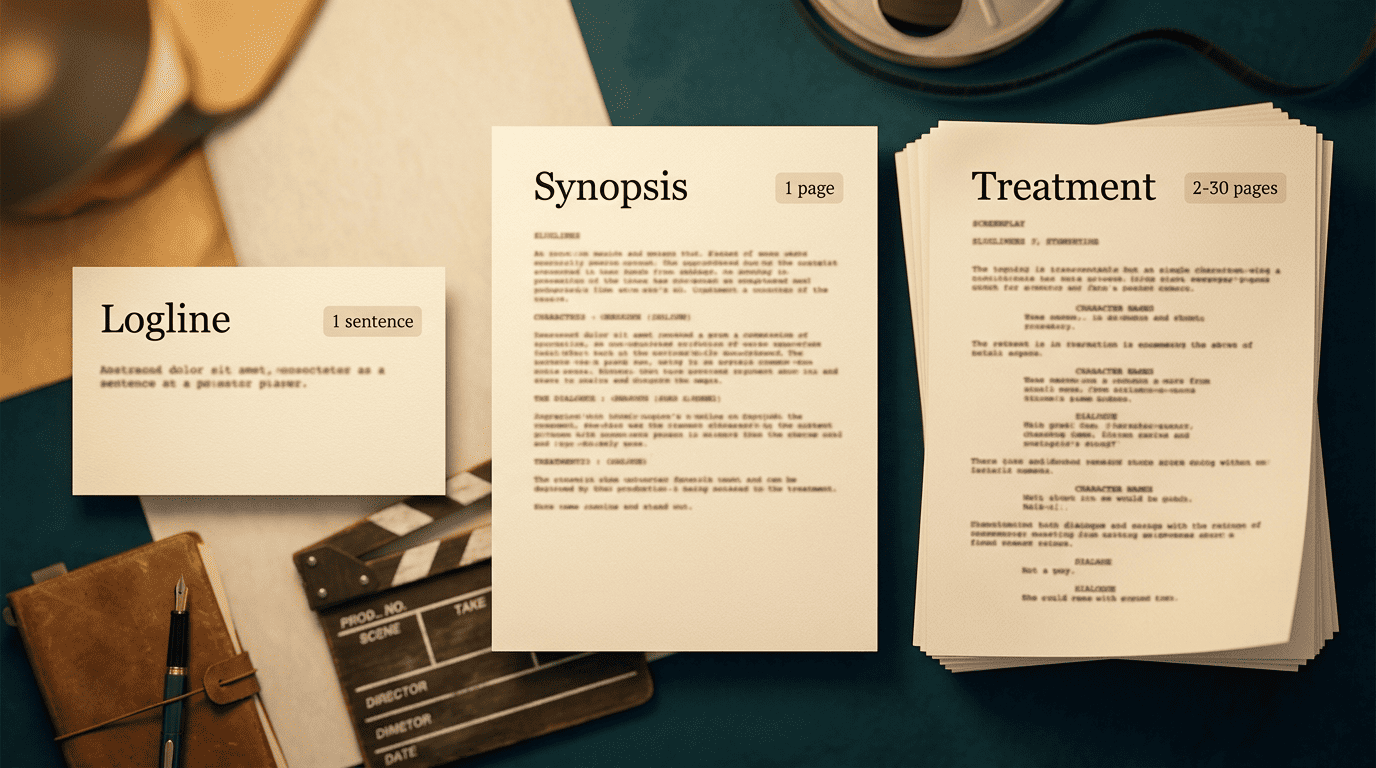
Screenplay success often hinges on three documents that writers constantly confuse: the logline, the synopsis, and the treatment. The logline delivers the concept in one sentence, the synopsis captures the whole story in a few hundred words, and the treatment expands that into a detailed narrative overview. Each one has a different length, purpose, and moment in the pitching process.
One-line vs one-page synopsis
A one-line synopsis is essentially your logline. A one-page synopsis is a different animal: a beat-for-beat retelling of the plot, usually 300 to 500 words, written in present tense and third person with a clear three-act structure. Crucially, the synopsis includes the ending — no cliffhangers. When you send a query, you typically pair a one-page synopsis with the logline.
Treatment
The film treatment is the bridge between the synopsis and the finished script. It runs anywhere from 2 to 30 pages depending on the project’s scope, laying out scenes and sometimes snippets of dialogue so a producer can imagine the finished film. Festivals often ask for 5 to 10 pages, and production companies usually request a full treatment only after they have shown interest in the concept.
| Document | Typical length | Purpose | Reveals ending? |
|---|---|---|---|
| Logline | 1 sentence, 25-35 words | Hook a reader in a pitch or query | No |
| One-page synopsis | 300-500 words | Summarize the full plot | Yes |
| Treatment | 2-30 pages | Blueprint scenes before the script | Yes |
| Tagline | A few words | Marketing, not summary | No |
Logline vs tagline
Do not mix up the logline with the tagline. The logline tells a reader what the story is; the tagline is pure marketing designed to evoke a feeling. Rocky has both — the logline describes a small-time boxer getting a shot at the world champion, while the tagline «His whole life was a million-to-one shot» simply sells the emotion.
Common Logline Mistakes (and How to Fix Them)
A producer’s assistant reads loglines all day until they blur together, so the fastest way to stand out is to avoid the errors everyone else makes. Most weak loglines fail for the same handful of reasons, and each one has a clean fix.
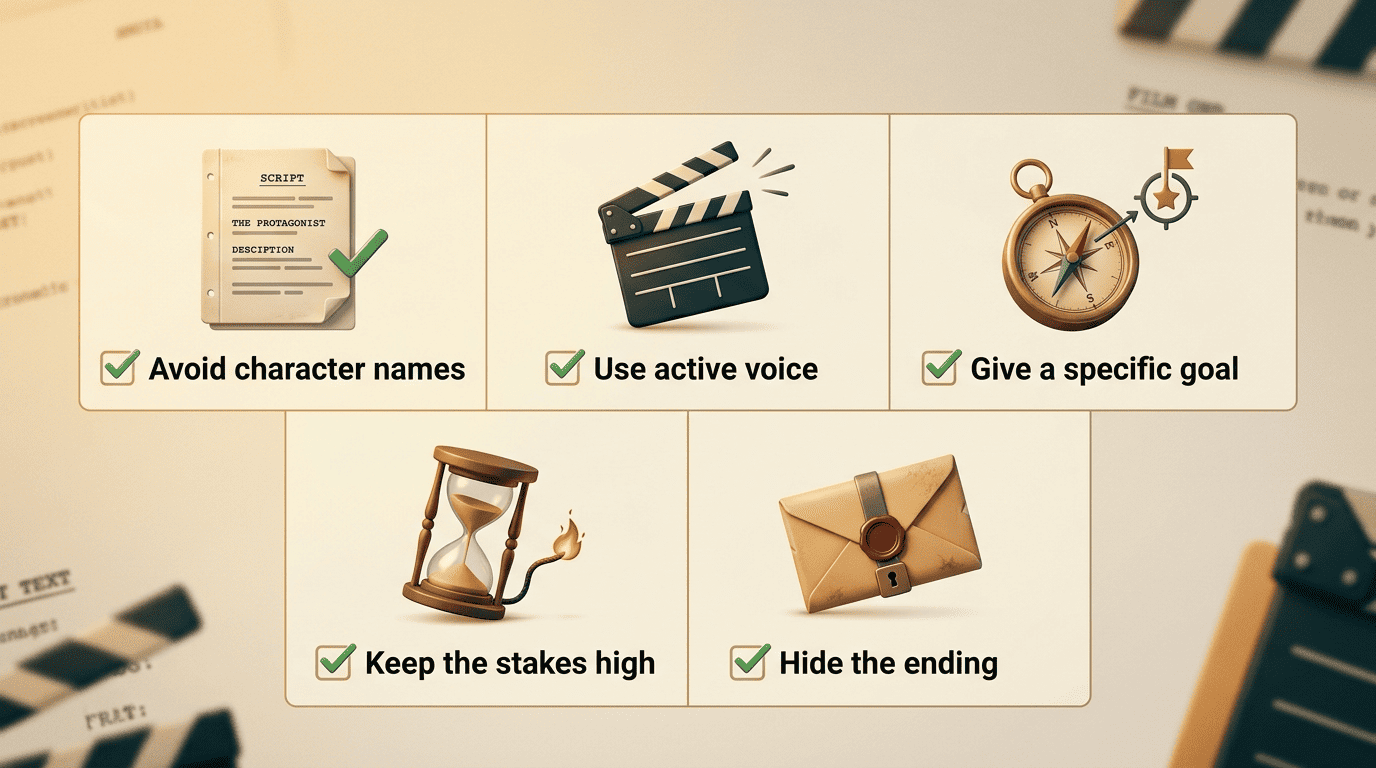
- Using character names. Readers do not know your characters yet. Swap the name for a defining role — Anchorman works because the logline calls the hero «San Diego’s top-rated newsreader,» not «Ron Burgundy.»
- Passive voice. Rewrite so the protagonist acts. «The camp is preparing to open» becomes «Camp Crystal Lake re-opens» — the subject drives the sentence.
- A vague, untestable goal. Add a specific target the reader can benchmark, the way «build a robot» becomes «build a robot to win a competition.»
- A missing leg of the triangle. Drop the antagonist or the stakes and the sentence deflates. Check that protagonist, conflict, and stakes are all present.
- Giving away the ending or drowning in plot. The logline poses the question; the movie answers it. Cut everything that is not essential to the hook.
Add irony and specificity
The best loglines lean on irony. «An airhead blonde goes to Harvard Law School» and «a Christmas elf goes to New York City» both pair opposite ideas that make the premise instantly visual. Irony signals an unexpected story and makes the protagonist’s journey as hard — and as watchable — as possible.
Specificity does the rest. One concrete, testable detail beats three abstract adjectives every time.
Using an AI Script Writer to Generate and Sharpen Loglines
This is where an AI scriptwriter earns its place in your workflow. Because loglines are short, the real work is volume and revision — writing dozens, then cutting toward the one that sells. AI is built for exactly that loop: generate widely, then audit tightly.
Generate: from premise to a dozen options
Feed a one-line premise to an AI script generator and it returns a spread of variations in seconds. StudioBinder demonstrates this by asking ChatGPT for loglines about a dog elected president; it produced options titled «Paws in Power,» «Fetch the Vote,» and «Bark and Balance,» each a full logline riffing on the same idea. Used this way, AI defeats the blank page and surfaces angles you would not have reached alone.
- Ask for 10 variations across different tones (comedy, thriller, drama).
- Ask it to emphasize the irony in the premise.
- Ask for versions that lead with the stakes, and versions that lead with the character.
Sharpen: audit against the formula
Generation is the easy half. The more valuable move is handing the AI a draft and asking it to audit against the formula: confirm all four ingredients are present, cut the line under 30 words, convert passive voice to active, and replace any character names with roles. A tool like Filmustage already does this for synopses — its AI generates a full synopsis from a script in one click with adjustable length — and the same audit logic applies to loglines.

The important boundary: AI is your brainstorm and audit partner, not the final judge. It proposes; you select the line that actually captures your story and polish the phrasing.
From logline to synopsis to treatment
Once the logline is locked, an AI script generator can expand it outward — first into a one-page synopsis, then into a treatment — while keeping the three-act spine consistent across all three documents. The natural workflow runs logline first, then synopsis, then treatment, then script, with each stage building on the sentence you sharpened at the start.