
AI Script Writer: What It Is, What It Does, and How to Use One
An AI script writer is a tool that turns a short prompt into a structured, formatted script — scenes, dialogue, action lines, and directions — for film, TV, YouTube, podcasts, and ads. Instead of staring at a blank page, you describe your idea and get an editable first draft in seconds.
It handles the mechanical heavy lifting of writing a screenplay — formatting, scene structure, character continuity — so you keep creative control and spend your time revising rather than starting from scratch. This page covers exactly what an AI script writer does, which formats it writes, how it works, free versus paid options, whether the output is any good, and how to get professional results from it.

What Is an AI Script Writer?
An AI script writer — also called an AI script generator, AI screenplay generator, or AI screenwriter — applies natural language processing and large language models to produce original scripts from your inputs. You give it plot points, character traits, a genre, a tone, and a dialogue style; it returns a draft shaped around them.
What separates it from a plain chatbot is specialization. A general AI writer produces prose; an AI screenwriting assistant is tuned to the grammar of scripts — scene headings, action lines, character cues, and transitions — and to the demands of specific formats like film, TV, podcasts, and short-form video.
It writes drafts, not finished films
The tool is an assistant, not an author. It generates a strong starting point, but the writer still shapes voice, subtext, and meaning. Think of it as a tireless collaborator that produces the first pass so you can focus on the rewrite.
The vocabulary it understands
A capable AI script maker knows what a slugline, an action line, a beat, and a logline are. That shared vocabulary is why the output reads like a script rather than a summary of one — it places each element where the format expects it.

What Does an AI Script Writer Do?
At its core, the tool converts an idea into structured, formatted pages. It handles four jobs that used to eat most of a writer’s time:
- Building scenes and holding structure across acts
- Writing dialogue in each character’s voice
- Applying screenplay formatting automatically
- Expanding a one-line logline into a full draft
Scenes and structure
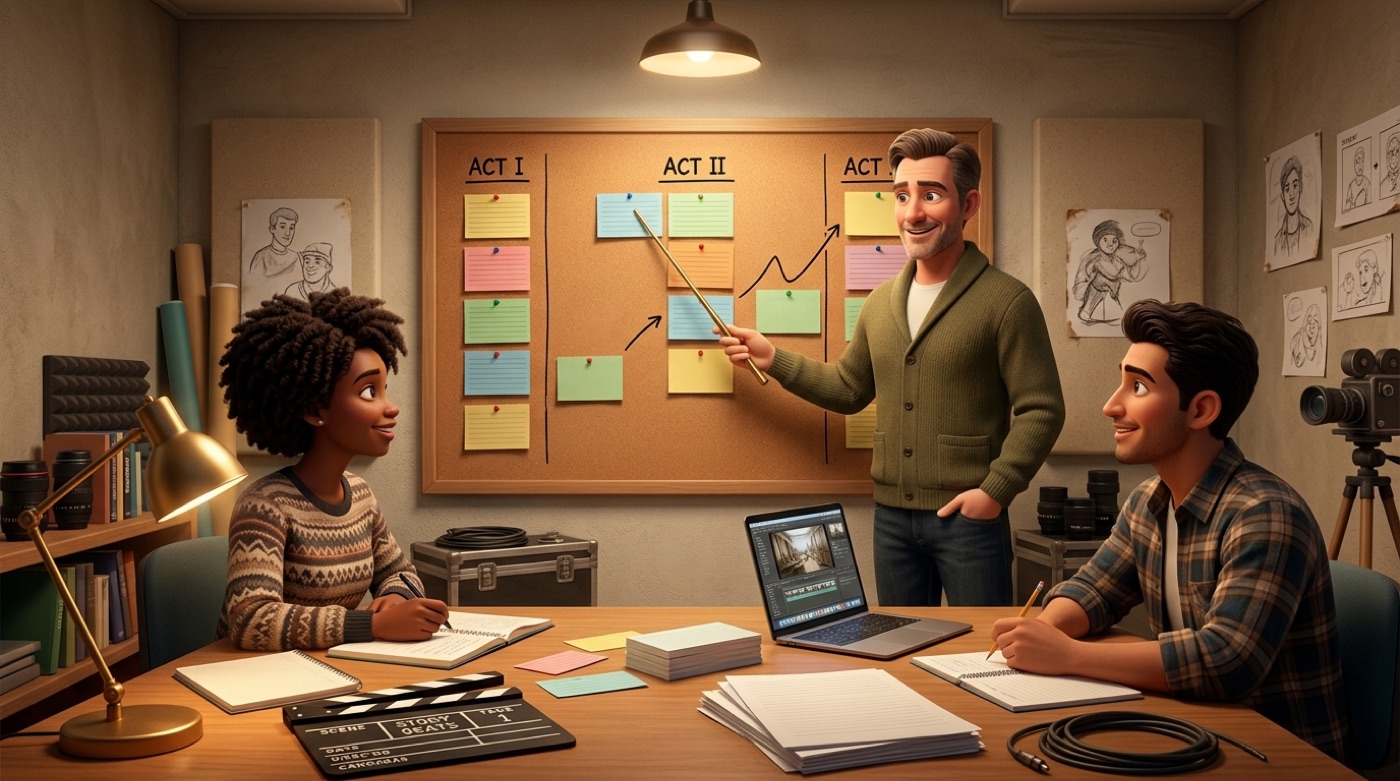
An AI script generator drafts scene by scene, maintaining continuity, pacing, and plot progression across acts. It reads your existing pages and continues the story with consistent character voices, so each new scene builds on what came before. You can generate a single scene or an entire act at once.
Dialogue
Dialogue is where the tool earns its keep. An AI dialogue generator writes lines matched to each character’s voice, with attention to subtext, conflict, and rhythm, and it lets you regenerate or rewrite any single line while leaving the rest of the scene intact.
Formatting
Every draft follows formatting conventions automatically — scene headings, action lines, character names, dialogue, and transitions land where they belong. Many tools also export to portable, plain-text screenplay formats like Fountain, so your script moves between apps without breaking its structure.
Loglines, outlines, and revisions
Beyond full scripts, an AI screenplay generator drafts loglines, beat outlines, and alternate openings or endings. Its rewrite tools tighten dialogue, shift tone, or restructure a section without forcing you to start over — useful for exploring several creative directions before committing.
What Formats Can It Write?
The same engine adapts to very different scripts by changing the conventions it applies. A movie scene, a podcast intro, and a 30-second ad have different structures, and a good AI script writer switches between them based on your prompt.
| Format | Typical use | Example prompt |
|---|---|---|
| Film / short film | Feature and short screenplays | “Draft a tense 3-page thriller scene in a stalled elevator” |
| TV pilot | Series openers with act breaks | “Write a sitcom cold open, two roommates, one missing cat” |
| Stage play | Dialogue-driven scenes, monologues | “A two-character stage scene about a delayed apology” |
| YouTube / TikTok | Hooks, host lines, calls-to-action | “A 5-minute YouTube script: a cat learns to cook, upbeat” |
| Podcast | Intros, interviews, narrative episodes | “A 1-minute podcast intro about burnout recovery” |
| Ad / marketing | Product spots and promos | “A 60-second upbeat ad script for a skincare brand” |
Film, TV, and stage
For screen and stage, the tool produces feature screenplays, short films, TV pilots, and stage plays with proper sluglines, act structure, monologues, and stage directions. This is the closest an AI screenwriter gets to traditional craft, and it is where careful editing matters most.
Video, podcasts, and ads
For creators and marketers, an AI script generator writes YouTube, TikTok, and Reels scripts with hooks and calls-to-action, plus explainers, educational content, podcast episodes, and ad copy. Some platforms even handle video-game dialogue. This is the highest-volume use of the technology today.
How Does an AI Script Writer Work?
Under the hood, the tool runs on large language models trained on huge volumes of text; it predicts the structure and dialogue that best fit the genre and format you request. You steer it through a short, repeatable loop rather than a single click.
Here is the typical prompt-to-draft workflow:
- Prompt — describe the genre, setting, main characters, and central conflict.
- Select style — set the tone and format (comedy scene, dramatic film, ad script).
- Generate — the AI returns a structured draft with scenes and dialogue.
- Check — review scene structure, character interactions, and pacing.
- Refine — adjust details, then generate the full-length script.
The more specific your prompt, the better the draft. Many tools then chain the finished script into production — feeding it into script-to-video, text-to-speech, or AI-avatar pipelines so a draft becomes a rough video without leaving the platform.

Free vs. Paid AI Script Writers
You do not have to pay to try the technology. Many script writing AI tools offer a genuine free tier, and some generate short scripts with no sign-up at all — enough to test the idea and produce short-form content.
Write with the door closed, rewrite with the door open.
Stephen King
That instinct — draft fast, then revise with judgment — maps neatly onto how the free and paid tiers divide up. Free tools are the fast, closed-door draft; paid tools add the length, exports, and production features you reach for when the door opens.
What free tiers give you
Free plans typically cover short scripts, a capped number of generations, and basic editing. For a YouTube intro, a social ad, or a practice scene, the free tier is often all you need.
What paid unlocks
Paid plans generally unlock longer-form generation, more revisions, file exports, and integrations such as script-to-video and voiceover. If you write at volume or need feature-length output that flows into a production pipeline, the paid tier is where that lives.
| Free tier | Paid tier | |
|---|---|---|
| Script length | Short / capped | Long / feature-length |
| Sign-up | Often none required | Account required |
| Exports | Limited | Full (PDF, Fountain, etc.) |
| Production tools | Rare | Voiceover, avatars, video |
| Best for | Trying it, short-form | Volume, features, pipelines |
Is an AI Script Writer Any Good?
Honestly assessed, an AI script writer is very good at some things and limited at others. Its real strengths are narrow but valuable:
- Speed — a full draft in seconds, not days
- Structure and formatting done correctly the first time
- A reliable cure for writer’s block
- Endless alternatives — scenes, openings, and endings on demand
The limitation is depth. Output arrives as a first draft that is technically correct but often generic; dialogue needs a human pass to carry real voice, subtext, and emotional truth. You should also check originality before commercial use and verify any facts in nonfiction scripts.
The human stays the author
Structure is mechanical; meaning is not. The writer remains the author of the work, and professional norms — including the position of the Writers Guild of America — treat AI as an assistive tool rather than a credited writer. The human editing pass is what turns a competent draft into a script worth producing.
How to Use an AI Script Writer Well
Getting professional results is less about the tool and more about how you prompt and edit it. Two habits do most of the work: write specific prompts, and treat every output as a first draft.
Write a specific prompt
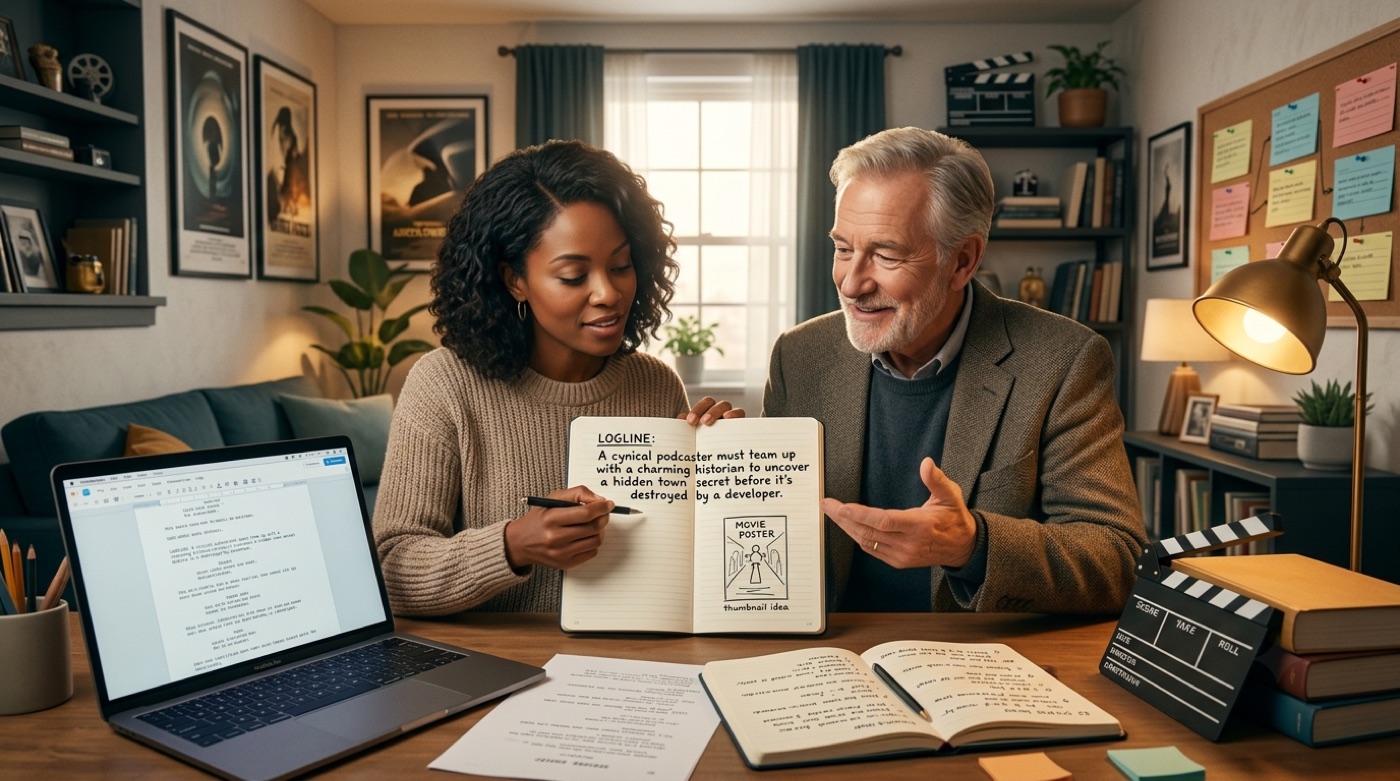
Vague prompts produce vague scripts. Instead of “funny video,” try “a funny 5-minute YouTube script about a cat learning to cook, upbeat tone, two characters, ends on a punchline.” Include genre, setting, characters, tone, and length — detail is what the engine rewards.
Iterate and edit
Regenerate lines you dislike, refine sections, and always do a human editing pass for voice and pacing before you call a script done. For final industry formatting, many writers move the draft into dedicated software such as Final Draft; AI output exports cleanly into these tools, so the AI handles the draft and the software handles the polish.
Who uses it
The user base is broad, and each group leans on the same strength — a fast, formatted first draft they can make their own:
- Screenwriters and playwrights drafting faster and breaking blocks
- Filmmakers and directors building pre-production material
- YouTube and content creators scripting at scale
- Film students learning structure and practicing dialogue
- Marketers turning briefs into video and ad scripts
Frequently Asked Questions
- What is an AI script writer?
An AI script writer is a tool that uses large language models to turn a prompt into a structured, formatted script — scenes, dialogue, and action lines — for film, TV, YouTube, podcasts, and ads. You describe the idea and it produces an editable first draft.
- Is there a free AI script writer?
Yes. Many tools offer a free tier, and some generate short scripts with no sign-up. Free access is enough to test the technology and to write short-form content; paid plans unlock longer output, exports, and production integrations.
- What types of scripts can it write?
Film and short-film screenplays, TV pilots, stage plays, podcast episodes and intros, YouTube, TikTok and Reels videos, explainers, educational content, ads, and even video-game dialogue — all steered by how you word the prompt.
- Can AI write a full movie script?
It can generate a full-length draft with scenes, dialogue, and correct formatting, but expect to revise heavily. AI is strong on structure and speed; a human pass is what gives the dialogue real voice and emotional depth.
- Are AI-written scripts any good?
They make solid first drafts — accurate on structure and formatting and great for beating writer’s block — but dialogue usually needs a human edit to feel natural, and you should check originality before any commercial use.
- Does an AI script writer format scripts correctly?
Yes. It automatically applies conventions like scene headings, action lines, character cues, and transitions, and drafts export into portable formats such as Fountain and industry software like Final Draft for final polishing.