
AI Script Writer for Ads: Write 15/30/60s Spots That Convert
An ai script writer turns a product and an audience into a tight, timed ad script — a hook, a problem, a payoff, and a call to action — in seconds instead of an afternoon. It borrows the same persuasion spine marketers have leaned on for a century, from the AIDA model of attention-interest-desire-action to modern short-form hooks.
For video marketing that means you can draft a 15-, 30-, or 60-second spot, spin off ten variations to test, and hold your brand voice steady — all before you ever open an editor.

What an AI script writer for ads actually does
An AI ad script generator ingests a product URL, a benefit list, or a one-line idea, then writes a structured script with a hook, body, and CTA. It is a drafting partner, not an autopilot: it removes the blank page while you keep editorial control.
From product to publish-ready copy
Feed it a landing page and the better tools pull your titles, prices, and images automatically, then draft copy sized for the placement. You describe the video idea; the AI scriptwriter returns a first draft you refine, rather than a finished ad you rubber-stamp.
The point is speed at the messy front of the funnel — the part where writers stall. You go from «I have a product» to «I have ten angles to test» in one sitting.
Ad script vs generic script
An ad script is built to convert inside a fixed window, not to entertain for minutes. Every second earns its place: no throat-clearing intro, benefit-led lines, and one clear action at the end.
That constraint is why a general chatbot prompt underperforms a purpose-built AI script generator. The advertisement script generator already knows the shape a paid-social spot has to take.
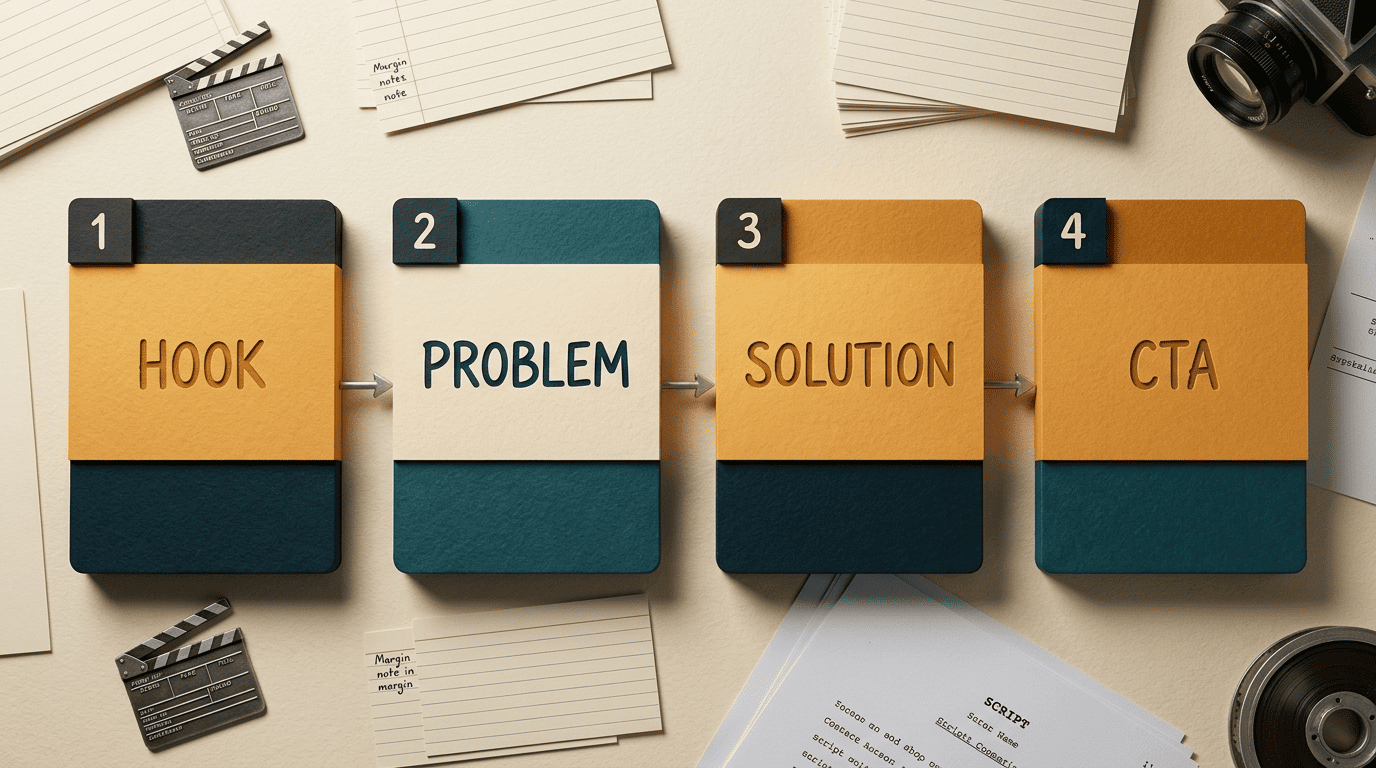
The anatomy of a converting ad script: hook-problem-solution-CTA
Almost every high-performing spot follows the same four-beat spine. Name it in your prompt and the output tightens dramatically.
- Hook (0-3s): stop the scroll with a question, bold claim, or pattern interrupt.
- Problem: name the pain your viewer already feels.
- Solution: position your product as the specific fix.
- CTA: ask for exactly one action — shop, sign up, learn more.
This maps cleanly onto the classic copywriting frameworks, so tell the AI which one to use:
| Framework | Beats | Best for |
|---|---|---|
| AIDA | Attention → Interest → Desire → Action | Broad awareness spots |
| PAS | Problem → Agitate → Solution | Pain-driven DTC products |
| Before-After-Bridge | Before → After → Bridge | Transformation stories |
| FAB | Features → Advantages → Benefits | Demo and explainer ads |
Why the hook is most of the job
On paid social the first three seconds decide whether the ad is watched or skipped, so weight your effort there. Prompt the AI for ten hook angles per concept and test them rather than betting on one.
David Ogilvy made the same point about print decades before the feed existed:
On the average, five times as many people read the headline as read the body copy. When you have written your headline, you have spent eighty cents out of your dollar.
David Ogilvy
The lesson translates directly: the hook is where most of your creative budget should go, whether a human or an AI script generator writes it.
Writing 15, 30, and 60-second spots
Length is the single most useful instruction you can give an AI script writer. Tell it the exact duration and it writes to the clock instead of past it.
Word budgets by length
At a natural ad pace of roughly 2.5 spoken words per second, each format has a rough ceiling. Overshoot it and your voiceover races or your captions get cut.
| Spot length | ~Word budget | What fits | Typical placement |
|---|---|---|---|
| 15 seconds | 35-40 words | One hook + one CTA | TikTok/Reels, bumper ads |
| 30 seconds | 70-80 words | Full hook-problem-solution-CTA | Meta feed, YouTube |
| 60 seconds | 140-160 words | Two benefits or a mini-demo | Explainer, consideration |
Matching length to platform
A 15-second cut suits top-of-funnel TikTok and Instagram Reels; 30 seconds is the workhorse for the Meta feed and YouTube; 60 seconds fits explainer and consideration-stage ads. Ask the AI scriptwriter for the same idea at all three lengths and one concept fills a whole campaign.
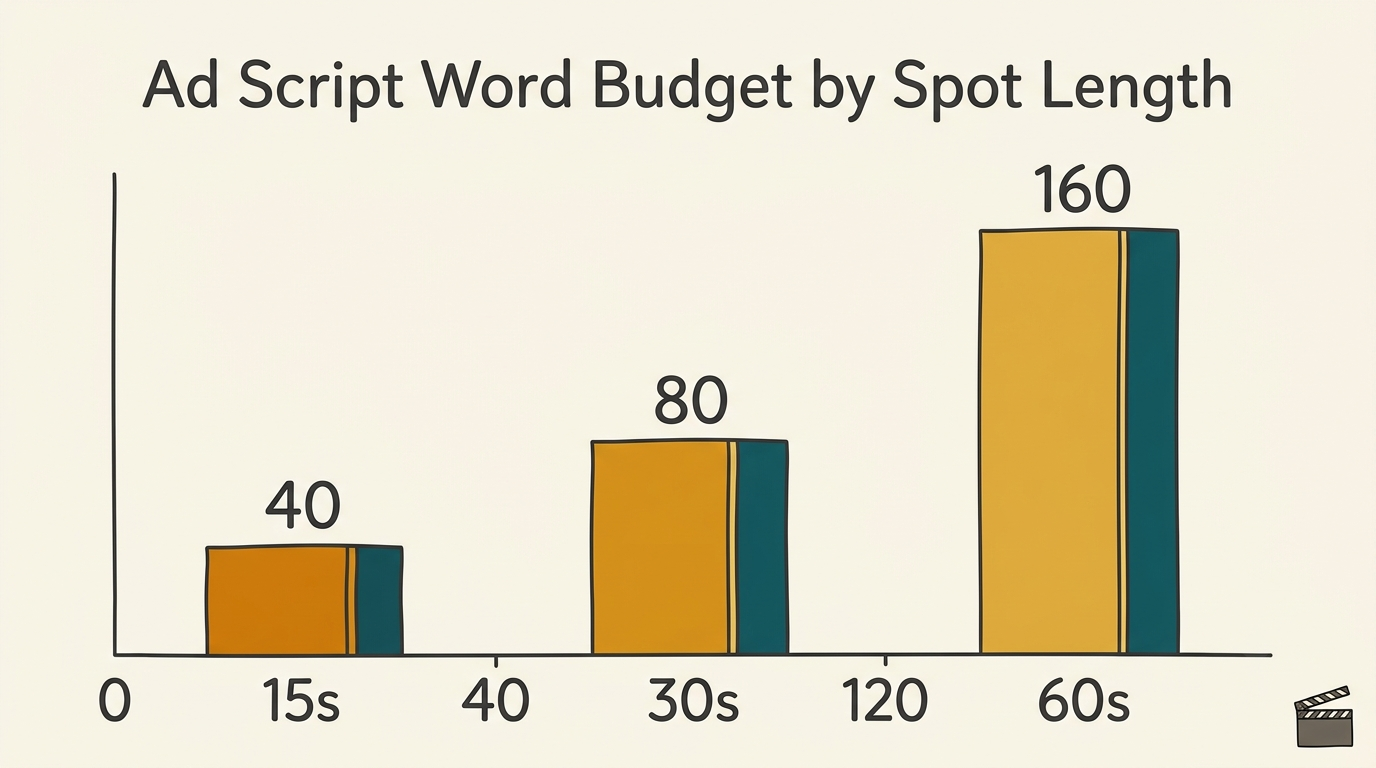
The habit worth building is one core message, many runtimes. You write the argument once and let the tool re-time it for each placement.
UGC, TikTok, and platform-native scripts
Short-form ads live or die on feeling native, and an AI ad script generator can be prompted to write for the format rather than against it.
Scripting UGC that doesn’t feel like an ad
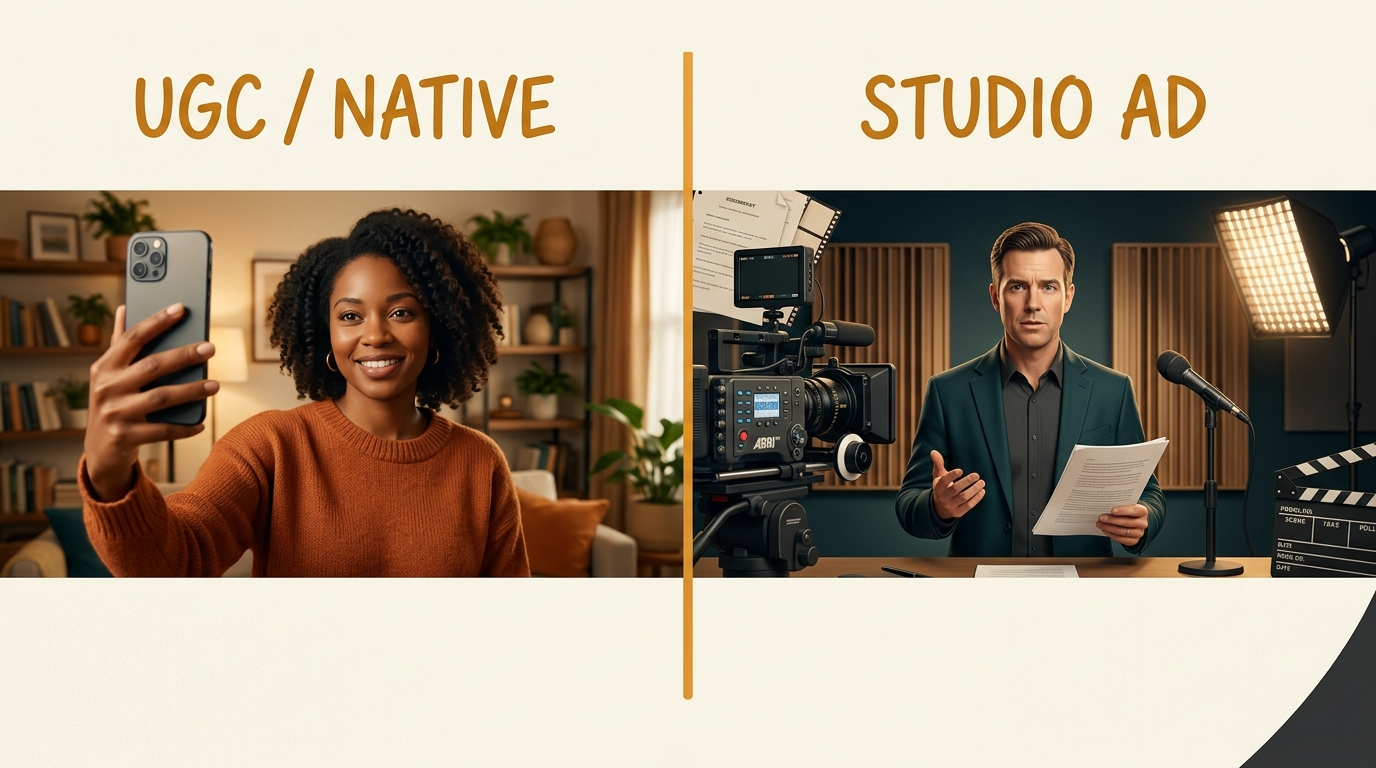
User-generated-content ad scripts read like a person talking to camera — first-person, casual, a real «I tried this» moment. Prompt for spoken-word phrasing, on-screen text cues, and B-roll notes, and the tool returns a scene-by-scene breakdown you can hand to a creator.
The tell of a bad UGC script is that it sounds written. Ask the AI script writer for contractions, filler-free but conversational lines, and a hook that starts mid-thought.
Native to each channel
Each platform rewards a different rhythm, so name the channel in your prompt:
- TikTok: raw, sound-on, trend-aware, first line spoken within a second.
- Instagram Reels: fast cuts, punchy captions, visual payoff early.
- YouTube pre-roll: brand named in the first five seconds, before the skip.
TikTok’s own creative team is blunt about why native beats polished — their guidance in the TikTok Business blog is that authentic, platform-native content consistently outperforms studio-style ads. Write the script to fit the feed, not the boardroom.
Brand voice, tone, and staying on-message
A script writer only sounds like you if you show it what «you» sounds like. Two or three examples do more than any adjective.
Feeding the AI your voice
Give the model a small, high-signal brief and it will echo your cadence and vocabulary:
- Two or three examples of your best-performing copy.
- A short do/don’t list (words you love, words you ban).
- Audience details — who they are and what they already believe.
For polishing a single line or trimming it to length, a paraphrasing tool such as Quillbot pairs neatly with a script generator: the AI drafts the structure, you tune the wording.
Guardrails
AI will happily invent claims and lean on clichés like «elevate your experience,» so treat every draft as unverified. Keep a banned-words list, and fact-check every specific number, price, or superlative before it ships — the model does not know whether your product is «the #1 rated» anything.
Generating and testing variations
The real unlock of an AI script writer is not one perfect script — it is cheap volume for testing.
One idea, many shots on goal
Generate ten to twenty variations that each change a single variable, so your test actually tells you something:
- Swap the hook while holding the offer.
- Swap the CTA while holding the hook.
- Swap the framework (Before-After-Bridge vs PAS).
- Swap the angle (price, speed, status, fear of missing out).
Purpose-built tools lean into this hard — some generate up to 20 scripts per product in about five minutes, which turns A/B testing from a luxury into a default.
Reading the winners
Follow a simple test-and-learn loop so the tool compounds instead of just producing noise:
- Generate 10-15 variations, each changing one variable.
- Ship the 3-5 strongest to a small budget.
- Let spend and watch-time pick the winner.
- Feed the winning hook back in as the seed for the next batch.
- Repeat, keeping only what beats the current champion.
Because each iteration is nearly free, you get more chances to find the angle that lifts return on ad spend — the metric that actually pays for the exercise.
How to prompt an AI script writer for ads
Specificity in equals quality out. A vague prompt gets a generic script; a precise one gets something close to shippable.
A prompt template that works
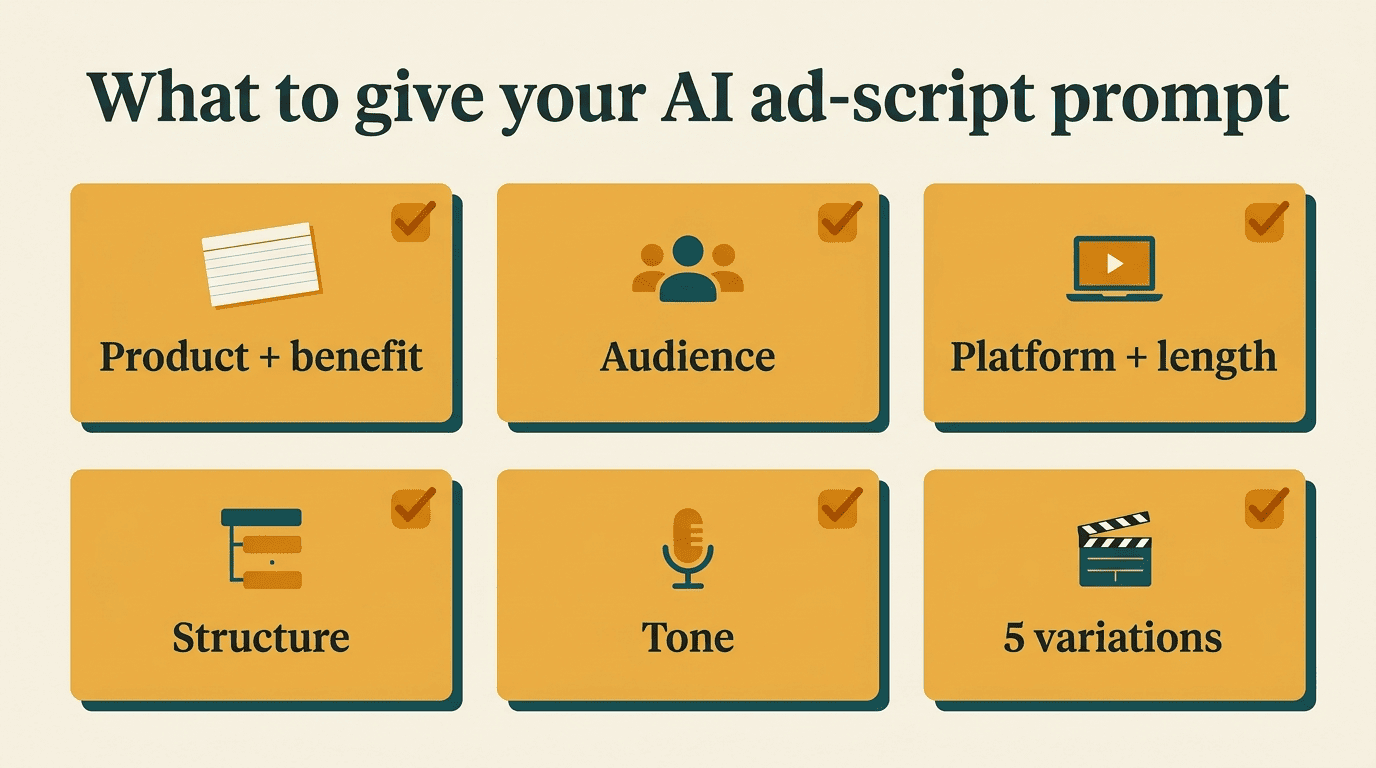
Hand the AI everything it needs in one message:
- Product + one-line benefit: what it is and why it matters.
- Audience: who you’re talking to.
- Platform + duration: e.g. «TikTok, 15 seconds.»
- Structure: «use hook-problem-solution-CTA.»
- Tone: casual, premium, funny — pick one.
- Volume: «give me five variations with different hooks.»
From script to video
Once the script lands, the same class of tools turns it into a finished ad with voiceover, captions, or an AI avatar, and animation platforms like Powtoon cover the explainer end. That closes the loop from idea to publish-ready spot without leaving the desk — the script is the hard part, and the AI scriptwriter just made it the fast part.