
AI Script Writer for Podcasts: From Blank Page to Ready-to-Record
Staring at an empty page is the slowest part of making a podcast. An AI script writer for podcasts turns a single topic into a full episode draft — outline, talking points, interview questions, intro, outro, ad reads and show notes — in seconds, so you spend your time recording instead of formatting. If you want a dedicated writing partner for exactly this, an ai script writer built for creators handles the structure while you keep the voice.

This guide walks through the six jobs an AI scriptwriter actually does for a show, with the structure real generators follow. The tool gives you the scaffold and the rhythm; your personality, anecdotes and opinions are what turn a draft into an episode.
Can an AI Script Writer Really Write a Podcast?
Yes — and it does more than spit out generic paragraphs. You feed it a topic, a tone, a target audience, a language and whether you host solo or with a co-host, and it returns a structured draft with an intro, main content and outro. Modern generators run on large language models that track context and flow, so the output reads conversational rather than robotic.
What it does with a single prompt
The input is deliberately light. Originality.AI’s generator, for example, asks only for a topic plus tone, audience, language and host count before producing a full outline. QuillBot’s AI script generator, rated 4.8 on Trustpilot, does the same for shorter pieces like a one-minute intro, and Descript’s «Ask AI to Write» lets you choose between a script, an outline or a brainstorming session from one prompt. Dedicated storytelling tools such as Squibler push the idea further for long-form narrative work.
AI drafts, you direct
The draft is a starting point, not a finished episode. The AI supplies the skeleton and the pacing; you layer in the jokes, the personal stories and the hot takes that make the show yours. That is the real value — it kills the blank-page fear so you can start editing instead of inventing.
Episode Outlines: From Idea to Structure in Seconds
The fastest win is the outline. Screenwriter William Goldman’s famous line about the craft applies just as well to audio: get the shape right and the rest follows.
Screenplays are structure.
William Goldman
An AI script writer applies that principle automatically, dropping your topic into a proven three-part backbone before you write a word.
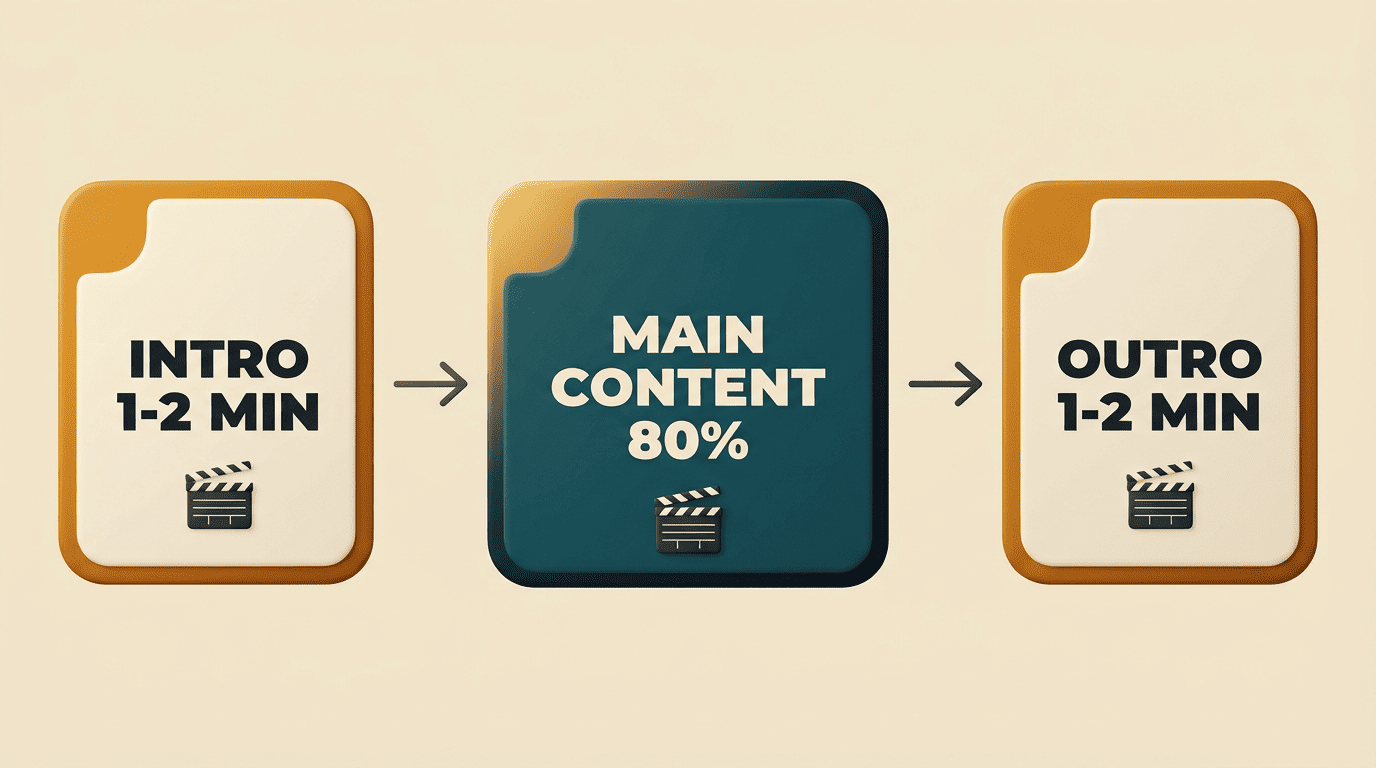
The three-part backbone
Most generators build the same shape a seasoned producer would: an intro of one to two minutes, a main body that fills roughly 80% of the runtime split into two to four segments, and an outro of one to two minutes, with short recap transitions between segments. The table below shows the structure a tool like SparkPod generates by default.
| Section | Length | Job |
|---|---|---|
| Intro | 1–2 min | Hook, welcome, episode preview |
| Main content | ~80% of runtime | 2–4 segments with your core points |
| Transitions | Seconds | Brief recaps between segments |
| Outro | 1–2 min | Key takeaways, call to action, next-episode tease |
Grow a one-liner into a full episode
You do not need a finished draft to start. A single sentence or a short bullet list is enough — the generator fills the gaps with context, examples and transitions to turn loose thoughts into a podcast-ready narrative. You can also repurpose an existing blog post or newsletter issue into a script, which is faster than writing from scratch.
Writing Interview Questions Your Guests Will Love
Interview shows live or die on the questions, and this is where an AI script generator quietly shines. Give it your guest’s name and a short bio, and it maps out a complete conversation arc instead of a flat list.
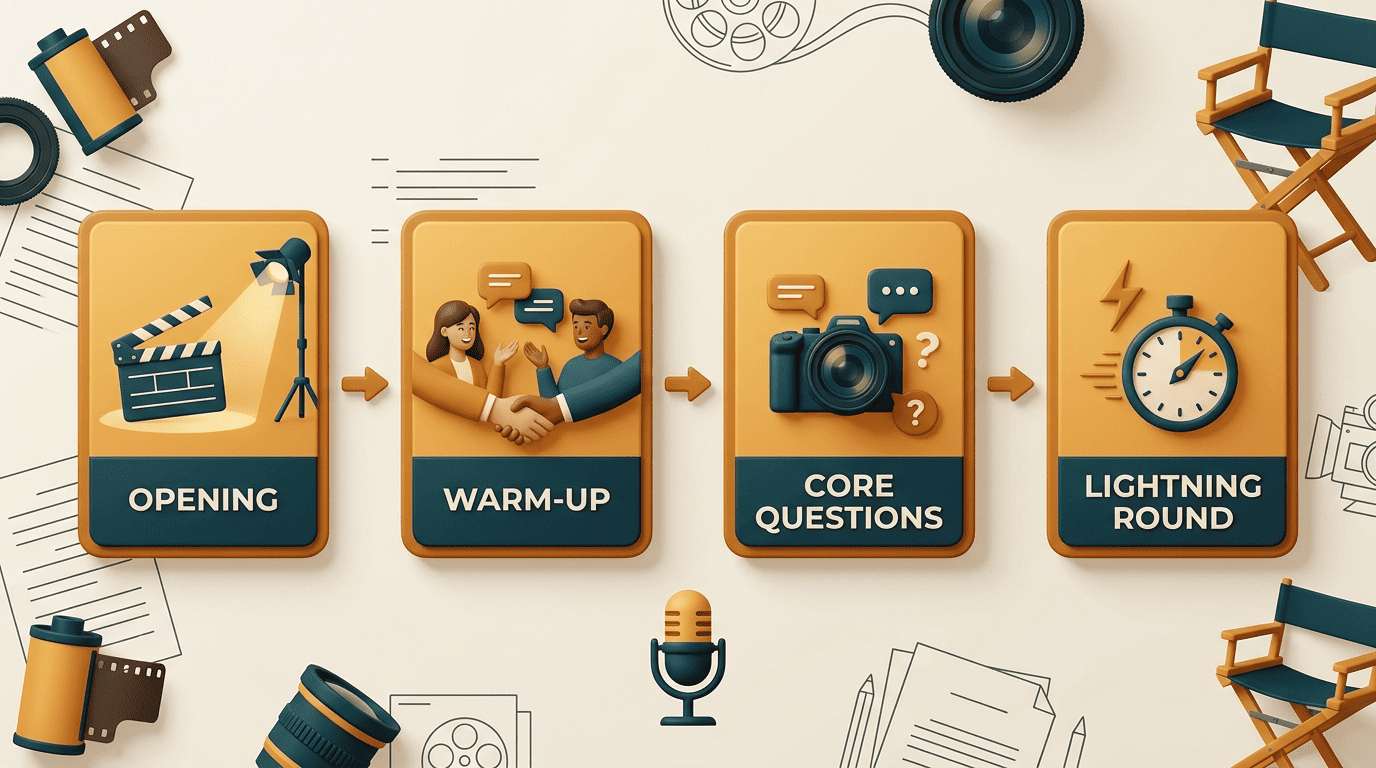
A ready interview arc
The structure mirrors what experienced hosts use, and the AI orders the questions so the conversation escalates naturally rather than jumping around.
| Stage | Length | What it covers |
|---|---|---|
| Opening | 1 min | Welcome, guest intro with credentials |
| Warm-up | 3–5 min | Rapport-building background questions |
| Core questions | 20–40 min | 5–10 prepared questions with room for follow-ups |
| Lightning round | 5 min | Quick-fire questions, plugs, thank you, CTA |
Follow-ups that dig deeper
A canned questionnaire feels stiff on air. Ask the generator to draft two or three follow-up questions for each core prompt, and you walk in ready to chase the interesting answer instead of racing to the next item on your list.
Intros, Outros, Hooks and Ad Reads
The opening seconds decide whether anyone stays. Podcast research and platform data agree the first 30 seconds determine whether a listener keeps going or skips, so this is the highest-leverage place to let AI generate options.

Hooks that stop the skip
Ask for several hook variations and pick the sharpest. The strongest openers usually fall into a few patterns:
- A provocative question that names the listener’s problem
- A surprising statistic or counterintuitive claim
- A bold, one-line promise of what they’ll walk away with
- A teaser of the guest’s story or the episode’s biggest moment
QuillBot’s sample output for a one-minute intro on burnout recovery shows the pattern in action: a warm welcome, a teaser of the guest’s story, and a promise of what the listener will get. A strong hook is a written craft, and AI is fast at drafting ten versions so you can choose one.
CTAs and ad reads that don’t feel canned
Every episode should end with a call to action you actually scripted — subscribe, leave a review, visit a link — rather than something you improvise and forget. The same tool writes ad reads in your voice, weaving the sponsor into a short story or a genuine recommendation so the read lands as part of the show instead of an interruption. Here is a quick way to brief the AI for a clean ad read:
- Give it the product, the sponsor’s one key message and any must-say legal line.
- Set the tone to match your show — casual, expert or playful.
- Ask for a 30-second and a 60-second version.
- Tell it to open with a personal angle, not the brand name.
- Read the draft aloud and trim anything you would not actually say.
Narrative and Scripted Shows
Not every podcast is two people talking. For audio drama, documentary series and tightly scripted solo shows, an AI scriptwriter handles story architecture as well as dialogue.
Story structure for fiction and docu podcasts
For narrative formats the generator follows a dramatic arc: a cold open of one to two minutes, a five-minute setup that establishes characters and stakes, fifteen to twenty-five minutes of rising action, and a five-to-ten-minute climax and resolution. QuillBot can brainstorm characters, plot arcs and dialogue, which is useful groundwork for a fiction podcast before you refine each beat by hand.
Keeping tone consistent across episodes
Serialized shows need a steady voice from episode to episode, and that consistency is hard to hold across a busy season. Because AI-generated scripts follow a clear structure and tone, they make it easier to stay on brand even when a different person drafts an episode.
Show Notes, Repurposing and Publishing
The script is only the start of the paperwork. A good AI workflow squeezes several deliverables out of the same draft, so one writing pass feeds your whole publishing checklist.
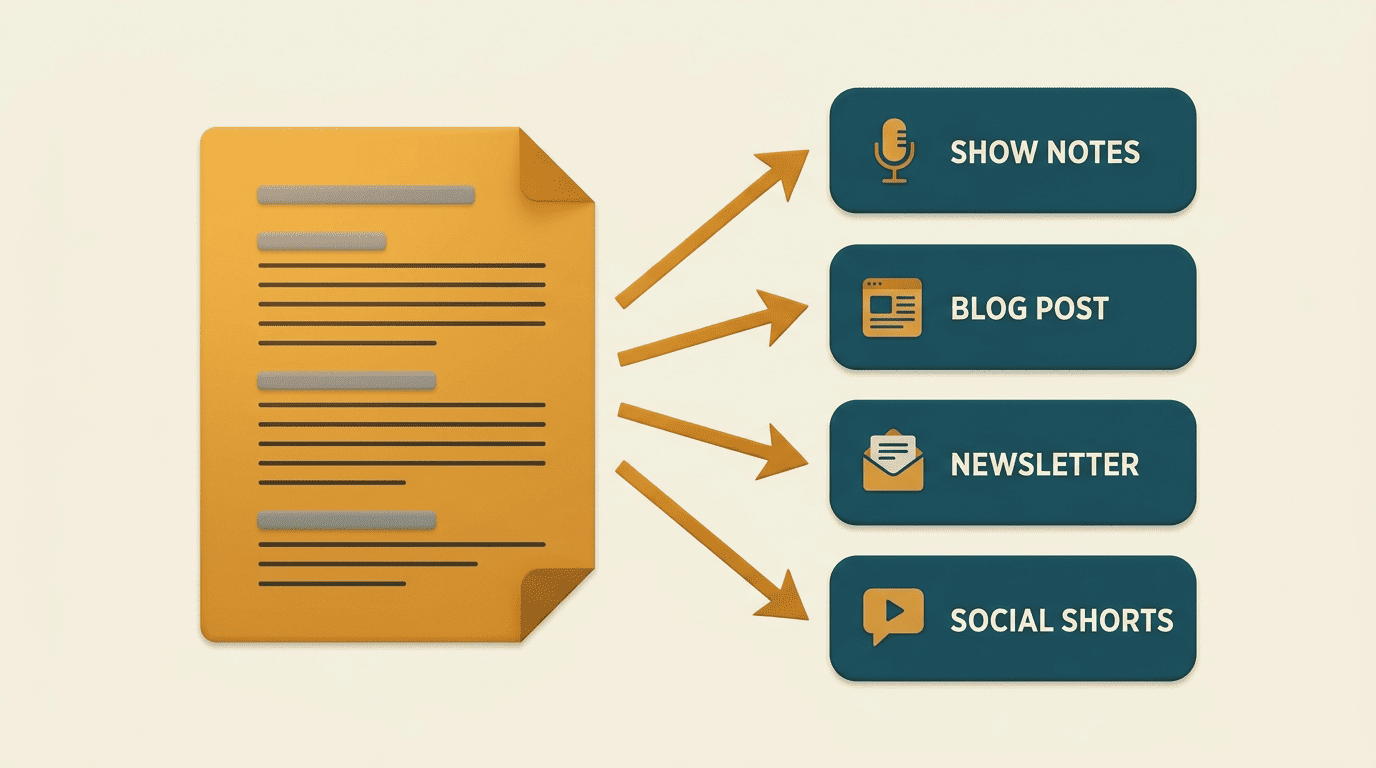
From script to show notes in one pass
Tools like Recast Studio auto-generate a whole promotion kit from a single episode:
- Show notes and a timestamped episode summary
- SEO-friendly titles and a companion blog post
- Email newsletter copy
- Social captions and 30-plus short video clips
On the production side, Descript can turn the script into an AI voice or a recording, capture up to ten remote guests, and export straight to platforms — you can publish the finished audio to Spotify or YouTube without leaving the workflow.
One script, many formats
Repurposing runs both directions. One episode becomes a blog post, a newsletter and 30-plus social shorts; equally, an existing article becomes a podcast script. That loop is how small teams keep a full content calendar without writing everything twice.
Making AI Scripts Sound Human
The one trap with any generator is reading it word for word. A script exists to guide you, not to be performed like a teleprompter.
Reading a fully written script verbatim sounds robotic, and listeners can tell the difference between speaking and reciting. Pull the key points into bullet form and talk to them, keeping sentences short and jargon-free. Read the draft aloud once, mark every spot where you stumble, and rewrite those lines the way you actually speak. Do that and the AI’s structure disappears into a delivery that sounds entirely like you — which is the whole point of using a scriptwriter in the first place. Independent audience data from firms like Edison Research shows how competitive listening has become, and a natural, well-paced delivery is a big part of what keeps an audience coming back.