
AI Script Writer for Movies: From Logline to a Feature Screenplay
An AI script writer turns a one-line idea into a formatted movie scene in seconds — but a feature film is roughly 120 pages of deliberate structure, and that is where the real craft begins. Used well, an AI scriptwriter is a co-pilot across four stages: the logline, the three-act structure, the scenes in industry format, and the rewrite. The tools are built on the same large language models behind systems the Writers Guild of America now writes rules about, so they understand screenplay conventions — not just grammar.
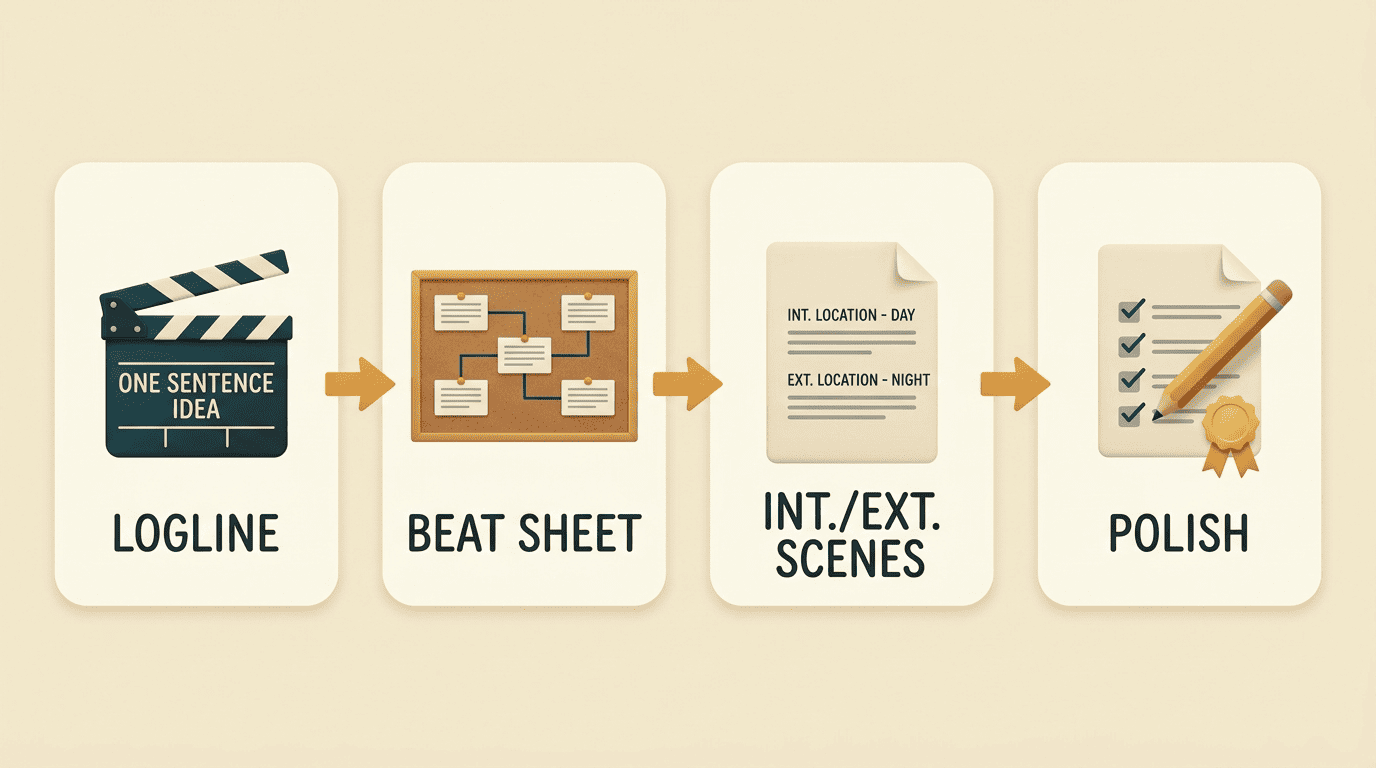
This guide walks the full path a movie takes: logline to beat sheet to INT./EXT. scenes to polish. Along the way it marks exactly where an AI script generator leads and where you, the writer, must take the pen.
What an AI Script Writer Actually Does for a Movie
An AI script writer is a tool that uses artificial intelligence to draft, structure and refine scripts for film. Instead of staring at a blank page, you describe a concept and it returns a story-aware draft you can edit — a fundamental shift from software that only formats what you already wrote to software that helps generate it.
More than autocomplete — a story-aware co-pilot
Modern AI screenwriting tools are built on large language models, the same class as GPT-4 and Gemini, trained on thousands of existing screenplays. That training lets them grasp scene structure, dialogue rhythm, character consistency and even subtext.
Feed one a concept and it returns a structured draft rather than a wall of text. Squibler, for example, generates a full-length script from a single prompt, with scenes, action and directions already formatted — a starting point you shape rather than a page you fill from zero.
What it generates in one pass
From a prompt like «a detective who can read memories solves a crime in 2050,» an AI movie script generator such as Murphy instantly returns a first-pass package:
- A logline and short plot summary
- Character profiles and arcs
- A scene-by-scene breakdown
- Natural dialogue suggestions
First drafts arrive in hours instead of weeks. The catch: they are raw material, not a finished film — the emotional truth still has to be written in by hand, which is exactly where the human part of the process begins.
Step 1 — From Idea to Logline
The logline is the seed of the entire feature, and it is the first thing an AI script writer can sharpen for you. Get this sentence right and every downstream stage inherits its focus; get it vague and the AI builds on sand.
The logline is the DNA of the feature
A logline compresses your movie into one sentence built on a proven formula: When [inciting incident], a [protagonist] must [objective] despite [an antagonistic force]. Give an AI script generator a rough idea and it will return ten loglines, each with a slightly different hook — your job is to pick and tighten the one with genuine stakes. That single line becomes the DNA the AI reuses to build structure, characters and scenes.
A strong logline needs three ingredients working together:
- A protagonist with a clear, active goal
- An inciting incident that forces the story to move
- An antagonistic force that makes the goal genuinely hard
Step 2 — Structure: Three Acts and a Beat Sheet
Once the logline is locked, structure is the next mountain — and it is where AI’s pattern recognition earns its keep. Most feature screenplays run on a three-act spine, and an AI scriptwriter can map yours in seconds.
The three-act spine
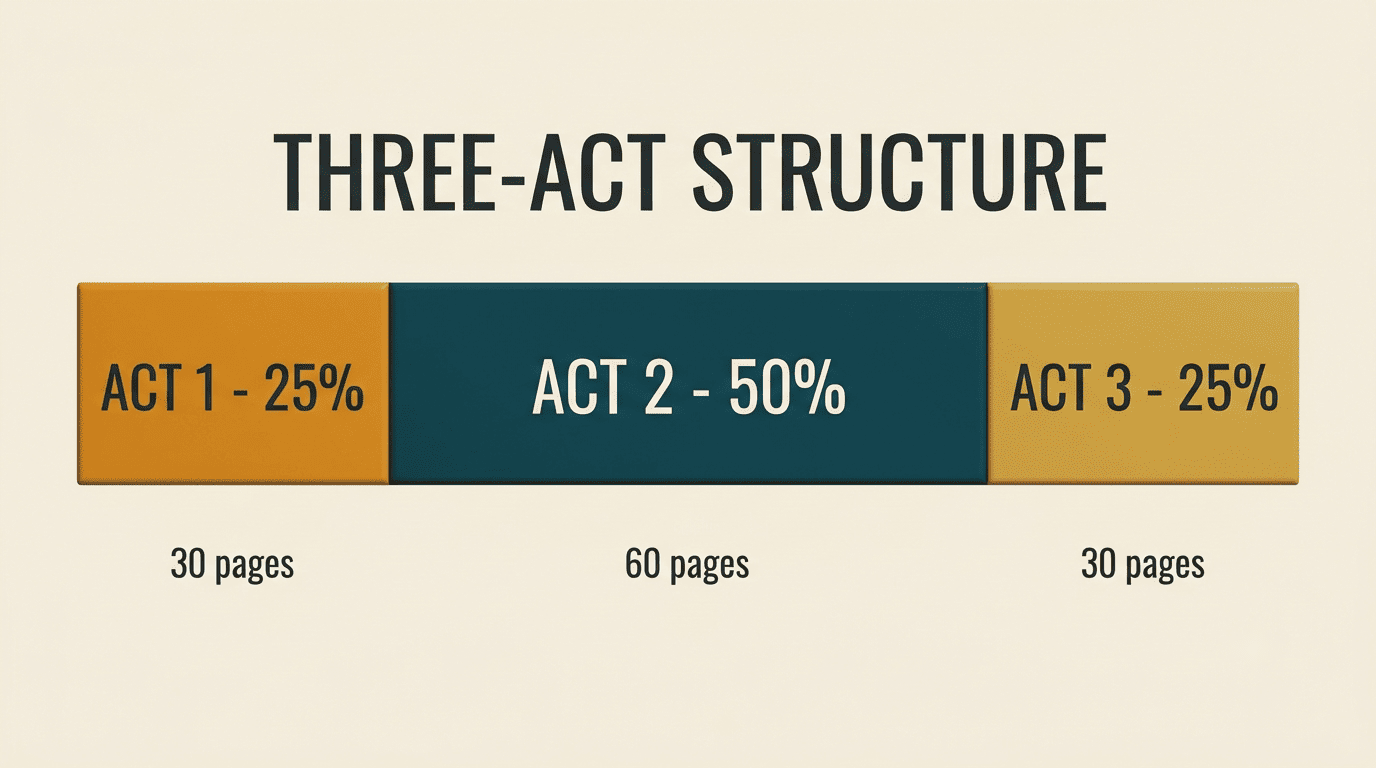
Act One sets up the world and delivers the inciting incident. Act Two escalates complications toward the midpoint reversal and the «all is lost» low. Act Three drives to the climax and resolution. The proportions are remarkably consistent, and because one properly formatted page equals about one minute of screen time, a 120-page script is a two-hour movie.
| Act | Share of script | Drama (pages) | Comedy (pages) | Job it does |
|---|---|---|---|---|
| Act One — Setup | ~25% | ~30 | ~24 | Introduce world, deliver inciting incident |
| Act Two — Confrontation | ~50% | ~60 | ~48 | Raise stakes, hit the midpoint reversal |
| Act Three — Resolution | ~25% | ~30 | ~24 | Climax and satisfying resolution |
Let AI draft the beat sheet
Hand the AI your logline and it can generate a complete beat sheet based on classic frameworks like the Save the Cat! structure or the Hero’s Journey. A typical sheet lays out the catalyst, the debate, the break into Act Two, the B-story, the midpoint, the «all is lost» moment and the finale.
Treat this skeleton as something to interrogate, not obey. Move any beat that feels mechanical, delete the ones your story hasn’t earned, and re-prompt the AI for alternatives wherever a turning point lands flat.
The beat sheet is a map, not the territory — its value is speed, not authority, and the story choices stay yours.
Step 3 — Industry Format: INT./EXT., Action Lines and Dialogue
A feature screenplay is not prose — it is a blueprint with strict conventions, and clean formatting is what separates a professional draft from a hobby one. This is the stage where a dedicated AI script writer or screenwriting app saves the most time.
What «industry format» means
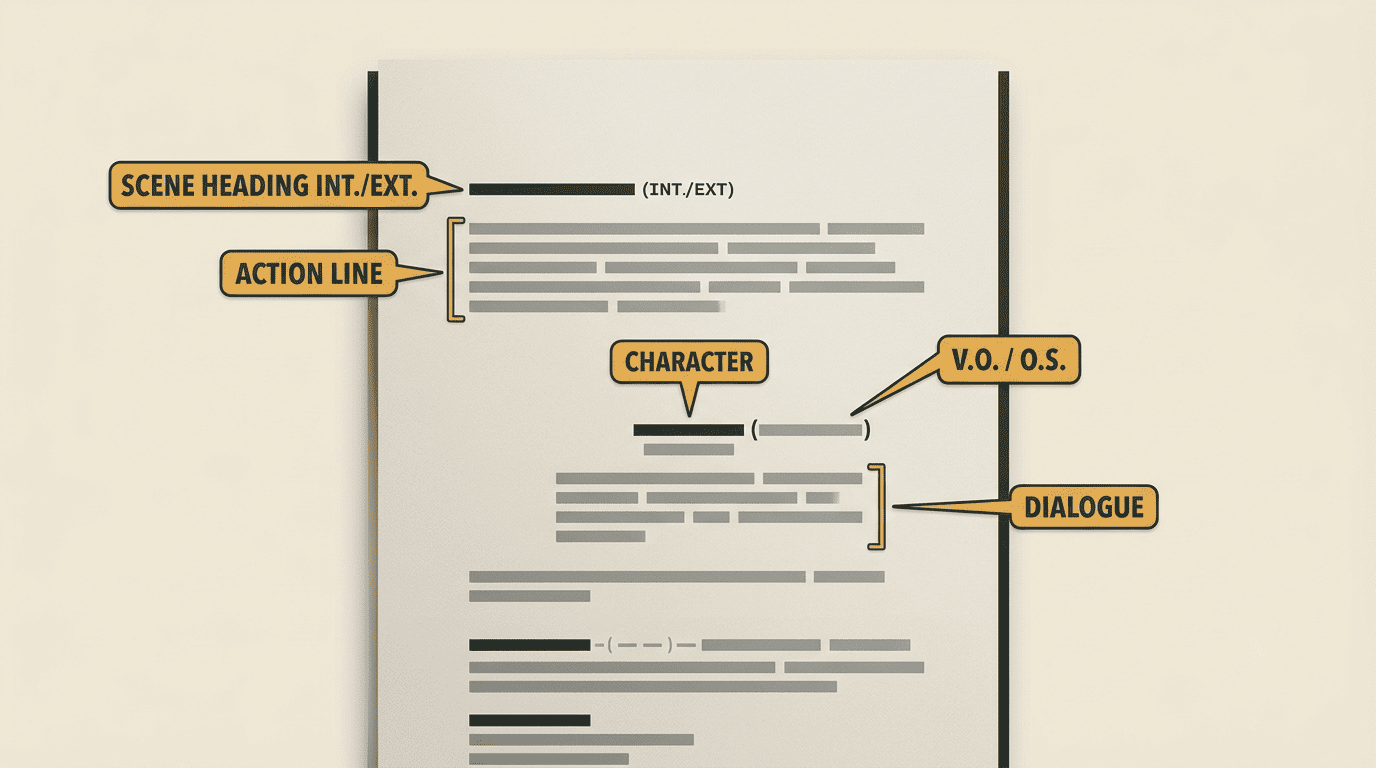
Scene headings — also called slug lines — read INT./EXT. — LOCATION — DAY/NIGHT. Action lines are written in present tense and never direct the camera, character names cap-center the dialogue beneath them, and parentheticals guide delivery. Three abbreviations mark where a voice comes from:
- V.O. — voiceover, narration laid over the scene
- O.S. — off-screen, a character heard but not shown in frame
- O.C. — off-camera, a variant used for a character present but not on camera
A good AI script generator places all of these automatically, so the first draft already reads like a screenplay instead of a short story. That is the single biggest time-saver an AI scriptwriter offers a movie project.
AI auto-formats, dedicated software finishes
Tools like StudioBinder apply industry-standard formatting from the first keystroke, track unlimited revisions with WGA-standardized color labels, and import work from Final Draft, Celtx, Fountain, Movie Magic Screenwriter or a plain PDF. General chatbots draft scenes well but struggle with strict formatting, so writers often move the draft into dedicated screenwriting software to finish it.
If you want to see the standard a script is measured against, the format used by industry-grade tools like Final Draft is the reference point. If you want to see the standard a script is measured against, the format used by industry-grade tools like Final Draft is the reference point.
Here is a simple workflow to take an AI draft to a formatted feature:
- Write a clear concept prompt with genre, tone, setting and central conflict.
- Generate loglines and pick the one with the strongest stakes.
- Ask the AI for a three-act beat sheet from that logline.
- Generate scenes one at a time, keeping character voices consistent.
- Rewrite the dialogue and action in your own voice.
- Move the draft into screenplay software (Final Draft, StudioBinder or Celtx) to lock formatting.
- Do a table read — many tools read the script aloud — and revise for pacing.
Step 4 — Where AI Helps vs Where the Writer Leads
An AI script writer is fast and tireless, but a movie lives or dies on emotion — and emotion is the one thing it cannot originate. Knowing the division of labor is what keeps AI a tool rather than a crutch.
The 60/40 rule of thumb. In real projects, teams report scripts landing around 60% AI-generated and 40% human-rewritten. AI is strongest at volume — ten versions of a hard scene, alternate endings, formatting and description — and weakest at emotional truth, subtext and originality.
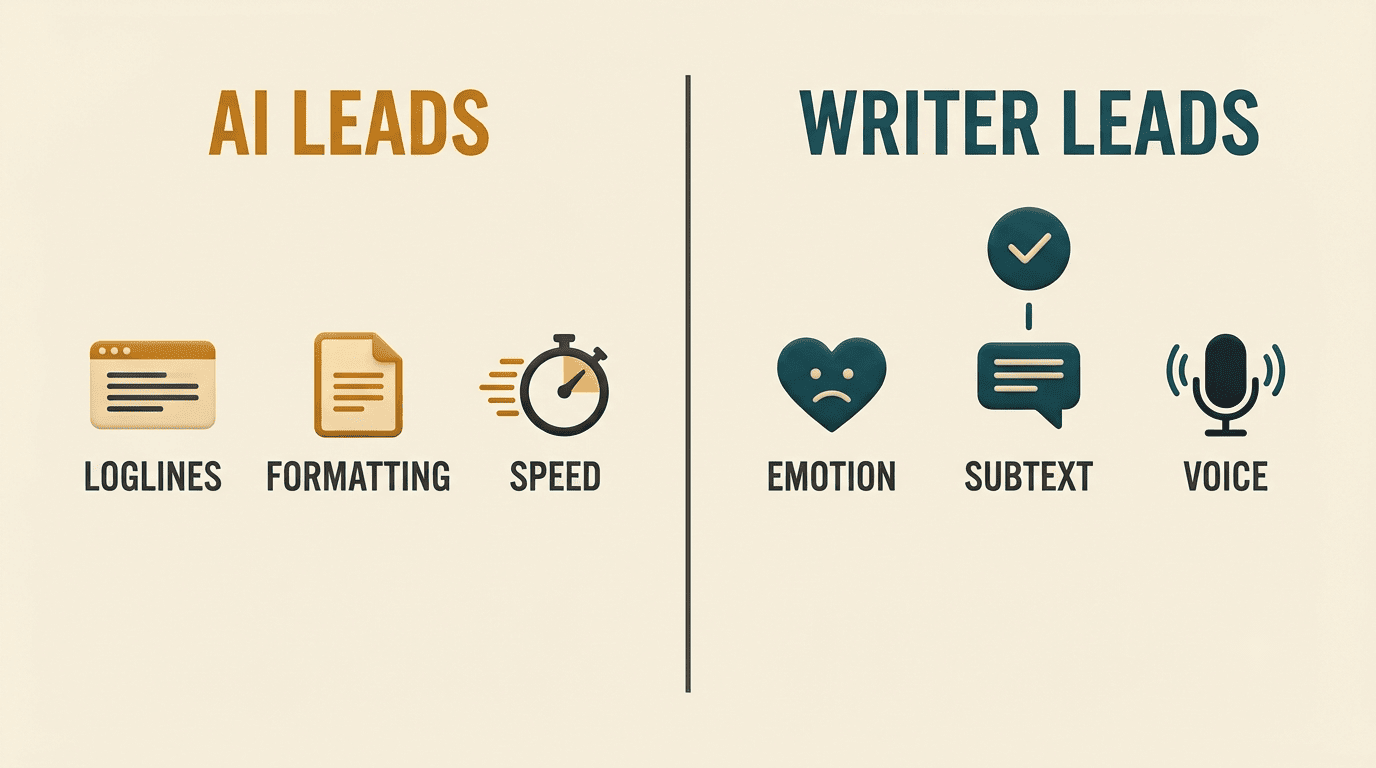
Watch for clichés and bias. AI defaults to worn phrases like «little did she know» and «suddenly,» and it can inherit bias from its training data — ask for a «brilliant scientist» and it may default to a white man. The writer stays the gatekeeper, actively challenging and editing every choice.
Run the iterative loop. The professional workflow is a cycle: generate, refine, integrate, repeat. Generate a scene with a detailed prompt, rewrite the flat lines in your own voice, fold the result back into the script, then use that as context for the next prompt. You stay the director; the AI just holds the flint.
The AI Scriptwriting Toolkit for Movies
No single AI script writer wins at everything, so the smart move is to match the tool to the job in front of you. Some excel at full formatted drafts, others at brainstorming, and a few now turn your script into visuals.
When AI technology determines the expressive elements of its output, the generated material is not the product of human authorship. As a result, that material is not protected by copyright.
U.S. Copyright Office
The tools split roughly into three lanes: full-draft generators, format-and-pipeline platforms, and creative-prose partners. Here is how the most-cited names compare.
| Tool | Best at | Screenplay format | Standout feature |
|---|---|---|---|
| Squibler | Full-length drafts from one prompt | Yes, automatic | Scene-by-scene generation |
| StudioBinder | Industry format + pre-production | Yes, automatic | Syncs to shot lists, storyboards, call sheets |
| Murphy | Script plus visuals | Yes | Built-in storyboard generator |
| Perchance | Quick free experiments | Partial | No sign-up, unlimited |
| Sudowrite | Emotional prose and subtext | No auto-format | «Describe» and «Expand» tools |
Pick by need. Reach for Squibler when you want a formatted draft fast, StudioBinder when the script has to flow into production, Murphy when you want to visualize scenes, Perchance for a no-cost test, and Sudowrite when a scene needs emotional depth before you format it elsewhere.
Rights, the WGA, and Keeping the Script Yours
The legal ground under AI screenwriting is still settling, and it directly affects whether your finished movie script is protectable. Two facts matter most for anyone using an AI script generator.
The U.S. Copyright Office has stated that purely AI-generated text is not copyrightable because it lacks human authorship, while a script created with meaningful human input may be protected. The 2023 WGA agreement added guardrails of its own:
- A studio cannot force a writer to use AI.
- AI cannot be used to replace a writer.
- AI-generated material is not treated as «source material.»
The practical takeaway is simple: AI is a tool you wield, and the human rewriting is what makes the script both stronger and legally yours.