
Using an AI Script Writer for Character Arcs: Track the Lie, the Want, and the Change
An AI script writer for character arcs is not a button that «writes the emotion» for you — it is a co-writer that holds the whole map of a character’s change in memory while you focus on the scene in front of you. Point a capable ai script writer at your logline and it can lay out a positive, negative, or flat character arc, name the Lie your protagonist believes, and mark exactly which beats that belief should crack.

This guide shows how to use AI to build and deepen a character’s transformation — not just spit out a bio. We cover the three arc types, the Want-versus-Need engine, the Lie the character believes, and how to map arc beats onto plot structure so the change actually lands on screen.
What a Character Arc Actually Is (and Where AI Fits)
A character arc is the internal transformation a character undergoes from the first scene to the last — the shift in what they believe about themselves and the world. It is the difference between a plot that merely happens to a character and a story that changes them. An AI scriptwriter is useful here precisely because an arc is a long-range pattern, and pattern-tracking across dozens of scenes is exactly where a human writer’s attention frays.
The arc as a package you can track
Sudowrite’s Novelist AI frames each arc as a structured package rather than a vague «she grows»:
- the character’s starting point;
- the journey and the transformation;
- their motivations and conflicts;
- their key relationships;
- and which chapters carry the change.
That is the same skeleton a screenwriter needs to keep an arc from collapsing the moment drafting begins. When the arc is stored as discrete parts, an AI script generator can check every new scene against it.
Why AI is genuinely useful, not just hype
An AI script writer is trained on large datasets of existing scripts, so it recognizes recurring patterns in dialogue, plot, and character development. In practice that means it can hold your character’s whole through-line in context while you draft a single scene — flagging a line that contradicts the arc, or a beat that should show change but doesn’t. It is an assistant, not a replacement, and the honest reason is where it falls short:
- emotional subtlety — the weight of a turning point rarely survives generation;
- subtext — AI tends to state what should stay unspoken;
- originality — unsupervised, it drifts toward familiar archetypes.
Those limits are the whole reason to treat AI as scaffolding: let it map and audit the arc, and reserve the emotional truth for yourself.
The Three Types of Character Arc AI Can Map
Before you prompt any tool, decide which of the three arc shapes you are writing. Naming the type up front keeps an AI script generator from drifting toward a generic «hero learns a lesson» default. The three types differ in one thing only: what happens to the Lie the character believes.

Positive change arc
The character starts believing a Lie, gets battered by the plot, and ends embracing a Truth — the most common Hollywood shape, from Woody in Toy Story to Elizabeth Bennet in Pride and Prejudice. Prompt the AI directly: «Give my protagonist a positive change arc — state the Lie in scene one and the Truth they reach by the climax.» Then ask it to show the Lie weakening in stages, not flipping all at once.
Negative (fall) arc
Here the character rejects the Truth and sinks deeper into the Lie — tragedy, corruption, disillusionment. Michael Corleone is the archetype. Ask the AI to track the escalating cost of clinging to the Lie so the fall feels earned scene by scene, rather than a sudden villain-switch in the third act.
Flat (steadfast) arc
In a flat arc the character already holds the Truth and instead changes the world around them — think Ted Lasso or Atticus Finch. This one trips up AI tools, because they instinctively look for change in the hero. Tell the tool explicitly to track the supporting cast’s arcs and how the protagonist’s steady belief reshapes them.
| Arc type | The Lie | Ending | Example |
|---|---|---|---|
| Positive change | Believed, then rejected | Character embraces Truth | Woody, Toy Story |
| Negative (fall) | Believed, then embraced harder | Character is destroyed by it | Michael Corleone, The Godfather |
| Flat (steadfast) | Never believed | World changes around them | Atticus Finch, To Kill a Mockingbird |
The Engine of Every Arc: Want vs Need and the Lie
The three arc types are shapes; the Want, the Need, and the Lie are the engine that drives all of them. This is the layer almost no AI tool surfaces on its own — you have to feed it in. Once you do, the quality of what a character arc generator returns changes completely.

The Lie the character believes
The Lie is the false belief a character holds at the start of the story — usually «I am only worth what I achieve,» «I have to do everything alone,» or some wound-driven misconception. Author and story-structure teacher K.M. Weiland built an entire framework around it:
At the beginning of the story, your character is going to believe some Lie about himself or the world.
K.M. Weiland
Feed the Lie to your AI script writer explicitly and it can thread doubt into dialogue, plant reminders of the wound, and mark the exact scene where the Lie finally breaks.
Want vs Need
The Want is the external, plot-level goal — win the case, get the girl, take the throne. The Need is the internal lesson that actually heals the Lie, and the two almost always pull in opposite directions. A reliable prompt: «List my protagonist’s Want and Need, then find the midpoint scene where they are forced to choose between them.» That collision — sacrificing the Want to grasp the Need, or clinging to the Want and losing the Need — is the beating heart of the arc.
Here is a five-step way to build the engine with an AI scriptwriter:
- State the Lie in one sentence.
- Name the Truth that disproves it.
- Write the external Want that the plot chases.
- Write the internal Need that heals the Lie.
- Ask the AI to find the scene where Want and Need collide.
Mapping Arc Beats to Plot Structure
An arc only works if its beats land at the right plot moments. A brilliant internal change means nothing if it happens in a scene the audience reads as filler. The job — and it is a job AI is good at — is overlaying the arc’s turning points onto the story’s structural spine.
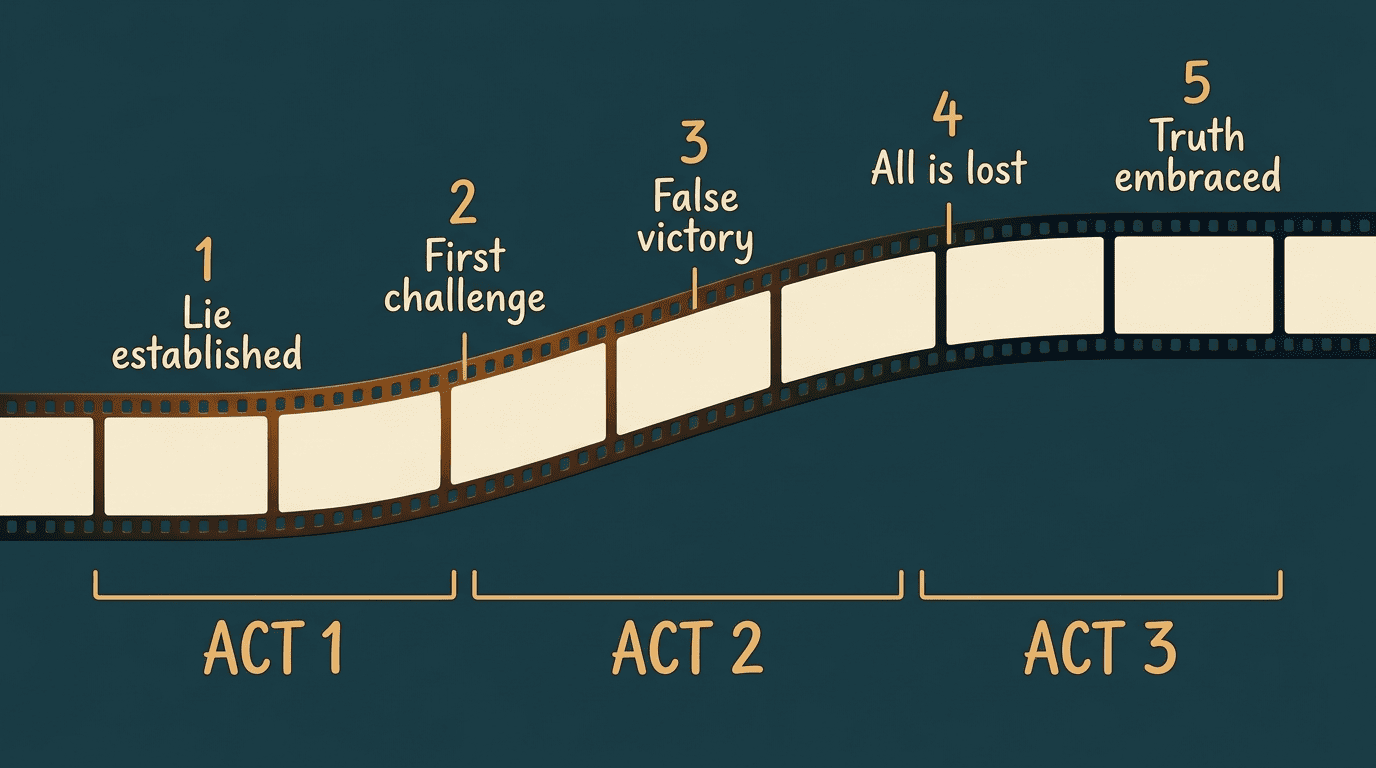
Aligning the arc to the three acts
In a three-act structure, the arc beats slot in predictably: the Lie is established in the setup, it takes its first crack at the Act One break, a false victory arrives at the midpoint, everything the character Wanted collapses at the «all is lost» low point, and the Need is finally embraced at the climax. AI tools already generate the plot spine — Sudowrite structures a story as setup, rising action, complications, climax, and resolution — so your task is to overlay the arc beats onto that spine and check that each one has a home.
| Plot beat | Arc beat | What changes |
|---|---|---|
| Setup | Lie established | We see the false belief in action |
| Act One break | First challenge to the Lie | Character resists change |
| Midpoint | False victory | Want feels within reach |
| All is lost | Want fails | The Lie’s cost peaks |
| Climax | Need embraced | Truth wins over Lie |
Keeping it consistent scene by scene
Squibler’s scene-by-scene drafting reads your existing pages and continues the story with consistent character voice and pacing. Used deliberately, that is arc maintenance in disguise: as you write forward, the AI can catch a scene where the protagonist «already learned the lesson» too early, or dialogue that betrays a change the plot hasn’t earned yet. Consistency checking across scenes is one of the few arc tasks AI does better than a tired human at 2 a.m.
How to Prompt an AI Script Writer to Deepen an Arc
The difference between a flat, tropey character and a resonant one is rarely the tool — it is the brief you give it. General models like ChatGPT and dedicated tools like Jasper will happily generate arcs and dialogue, but left vague they default to archetypes. A precise prompt sequence is what pulls depth out of them.
Lead with the Lie and the Truth. Before you ask for a single scene, give the AI the false belief and the truth that will replace it. Everything downstream — dialogue, conflict, beat placement — can then be measured against that spine.
Force it to subvert the obvious. Writer’s Digest found that ChatGPT served up stereotypes — the hard-boiled detective, the femme fatale — until the prompt changed to «how might I subvert these archetypes?» The second version was far more useful. Make subversion an explicit instruction, not a hope.
Use the AI as an interrogator. Ask it: «What are five questions I haven’t answered about this character?» A character arc generator is often more valuable asking questions than answering them, because the gaps it exposes are the ones your audience will feel.
Where AI falls short — and you don’t
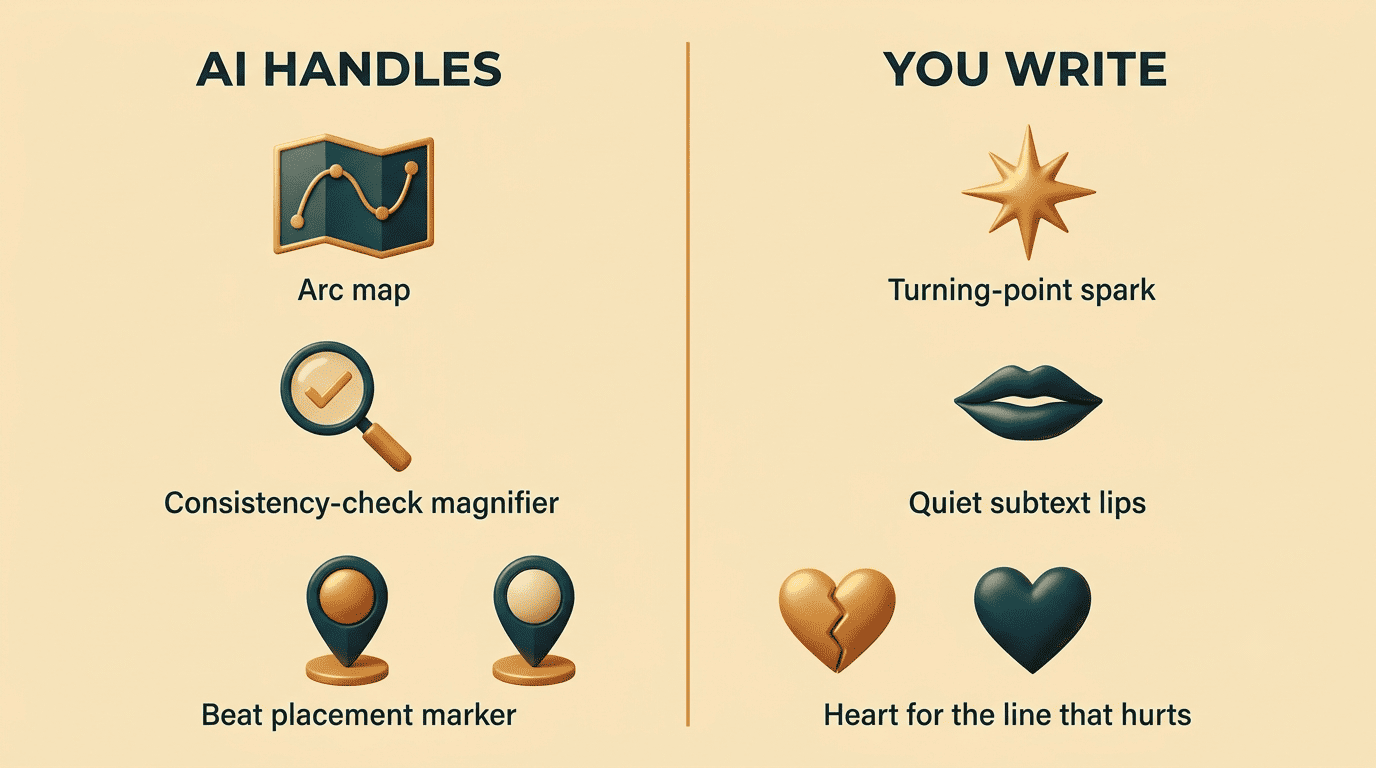
So divide the labor honestly. Let the tool own the scaffolding, and keep the human moments for yourself:
- AI handles: arc maps, consistency checks across scenes, beat placement, and archetype brainstorming.
- You handle: the moment of change, the loaded silence, the subtext, and the line that actually hurts.
That division is not a weakness of AI screenwriting; it is how you use it well.