
AI Script Writer for TV Pilots: Cold Opens, Act Breaks & a Series That Sells
A TV pilot has to do two nearly impossible jobs at once: work as a satisfying single episode and pitch an entire series in the same 30 to 60 pages. That double pressure is exactly where an ai script writer earns its place — it drafts your cold open, structures your act breaks, tracks your A, B, and C storylines, and roughs out a series bible while you keep hold of the story’s spine.
This guide walks through using an AI scriptwriter to move from a one-line logline to a pilot that reads like it could actually sell. It also marks the line where the tool stops and the human writer takes over, because as of 2026 that line still matters — legally and creatively.
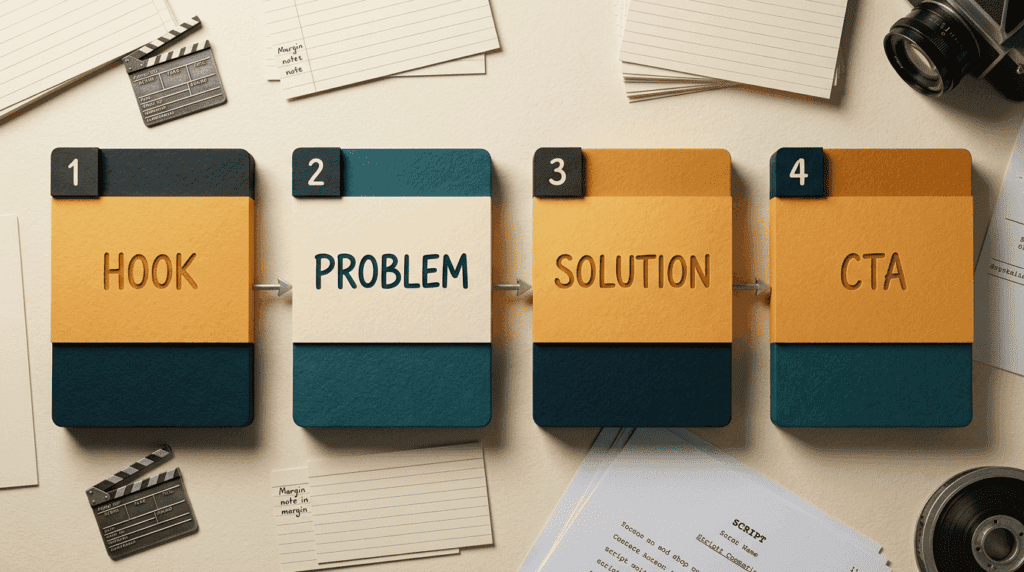
How an AI Script Writer Actually Drafts a Pilot
An AI script generator doesn’t start with a blank page. It starts with your prompt, and the quality of the pilot it returns is almost entirely a function of how specific that prompt is.
From logline to first draft in one workflow
Tools like Squibler take a short brief — character names, genre, tone, a few scene directions — and return a draft with proper scene headings, action lines, and dialogue, holding continuity across scenes. You review the scene structure, then expand it into a full-length pilot. Generators such as Vondy round-trip the result into industry formats, exporting to PDF, Final Draft, and plain text so you can hand it to a reader or drop it into a formatting app.
The practical loop looks like this:
- Write a one-sentence logline and a two-line premise.
- Prompt the AI script writer with genre, runtime, tone, and three to five recurring characters.
- Generate a beat outline first, not the full script.
- Review the beats for a clear cold open, act-outs, and a series hook.
- Expand the approved outline into a full-length draft.
- Generate alternate versions of the cold open and weakest scene.
- Hybridize — keep the best lines, cut the rest.
Feed it the right inputs
Specificity beats volume every time. Compare a vague prompt with a loaded one:
| Input | Vague prompt | Specific prompt |
|---|---|---|
| Format | «Write a TV script» | «Write a 22-minute single-camera comedy pilot» |
| Characters | «Some coworkers» | «Three recurring leads: a burned-out manager, an over-eager intern, a cynical veteran» |
| Structure | «Make it good» | «Cold open, A story plus B story, a final comic tag» |
| Engine | (none) | «Each episode, a small workplace lie spirals out of control» |
The specific version gives the AI scriptwriter a series engine and a shape to fill. The vague one gives it permission to write a generic short story.
The Cold Open: Hooking Viewers in the First 2–5 Pages
Everything before the title sequence is the cold open, also called the teaser. It usually runs the first two to five pages, and its only job is to grab the viewer before the credits roll.
What a cold open (teaser) is
A strong teaser teases the tone, atmosphere, genre, world, concept, and conflict — ideally introducing your protagonist in the same beat. On Wikipedia’s overview of the cold open you can see how consistently prestige and network shows lean on this device to set a hook before the audience has committed anything.
The reason to draft it with an AI script generator is variance. Ask for three different cold opens for the same premise — one built on a mystery, one on a character reveal, one on a set-piece — and pick the one that raises the sharpest question.

Make the AI’s teaser do double duty
A pilot teaser can’t just be a cool scene. Prompt the AI to end the cold open on a moment that promises both this episode and the series. If the opening image could belong to any episode of any show, push the tool to make it specific to your world and your engine.
Act Breaks: Structuring the Pilot Like the Networks Expect
After the teaser, structure diverges depending on where your show would live. This is one of the first things to tell your AI scriptwriter, because network and streaming pilots are built differently.
Teaser plus four (or five) acts
Network pilots follow strict act breaks timed to commercial placement — typically a teaser plus four or five acts and a short tag. Each act break has to land on a moment strong enough to keep viewers from wandering off during the ads. Streaming pilots allow looser or continuous structure, since there are no commercials to survive.
| Model | Structure | Act-out pressure | Typical runtime |
|---|---|---|---|
| Network comedy | Teaser + 2–3 acts + tag | Moderate, joke-driven | 22 minutes |
| Network drama | Teaser + 4–5 acts | High, each act-out escalates | 42–44 minutes |
| Streaming | Flexible or continuous | Softer, chapter-like | 30–60 minutes |
Tell the AI which model you’re writing for. A drama pilot built without act-outs will feel shapeless to a network reader, while a streaming pilot chopped into rigid commercial acts can feel dated.
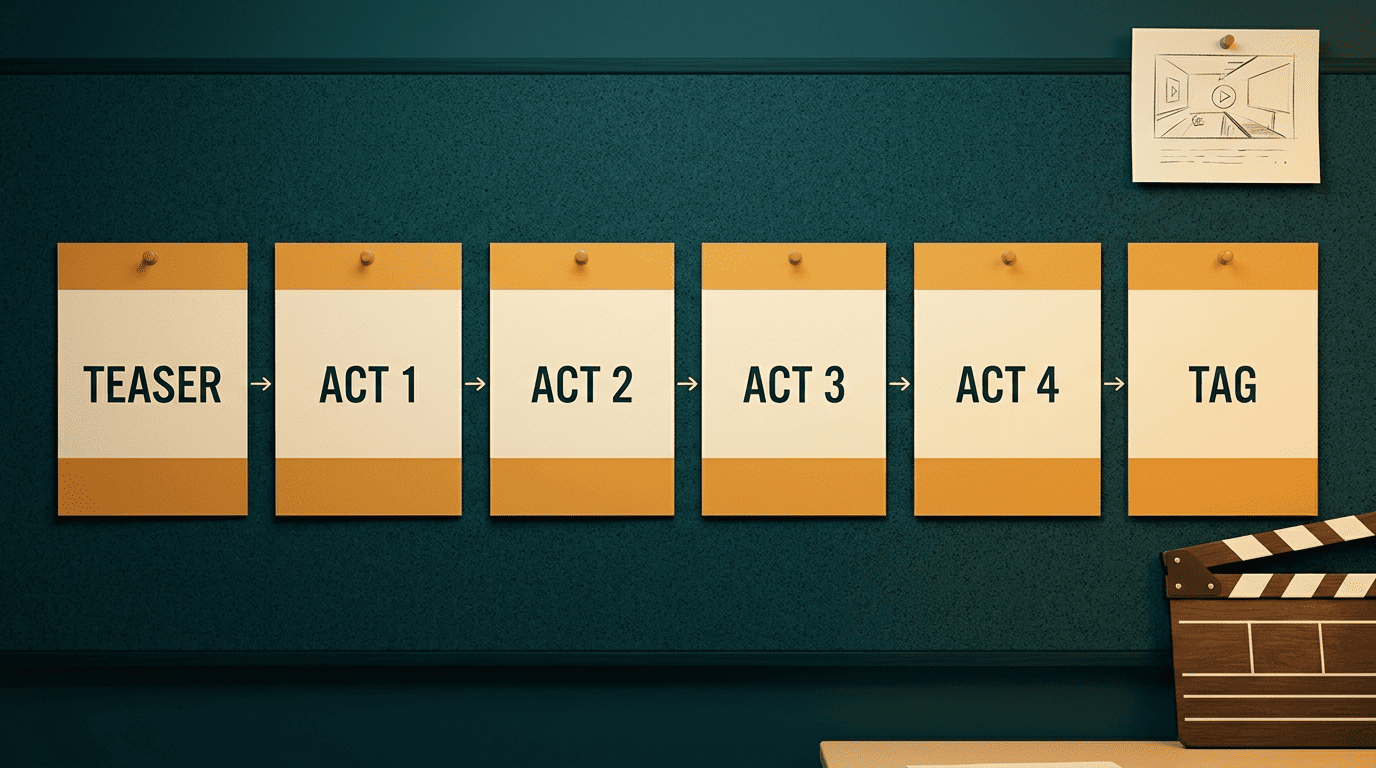
Use act-outs as pressure valves
An act-out is the complication or reveal that closes each act. Prompt the AI script writer for one at the end of every act, then check a single thing: does each act-out escalate the A-story objective, or just restate it? Escalation is what keeps a reader turning pages.
A, B, and C Storylines: Weaving an Episode That Breathes
A pilot that runs on one storyline feels thin. The craft is in braiding two or three threads so the episode has rhythm and the characters have room to breathe.
The A story is the engine. It carries a concrete objective for the episode — «find the missing witness before the storm hits» — and it drives the act structure. Every act-out should hit the A story.
The B story adds pressure. Usually it runs through a relationship or a secondary character, and it gives the episode emotional weight the plot alone can’t carry. It often intersects the A story at the climax.
The C story is the runner. Lighter, sometimes comic, it threads through the margins and pays off with a small button near the end. Not every pilot needs one, but ensemble shows lean on it.

When you prompt the AI, name the threads explicitly and ask it to tag which scenes belong to which story. Then keep your cast consistent — recurring characters need stable voices and goals across the draft. Paste your character descriptions into every prompt, or use a tool that reads your character bible as context, so the AI doesn’t collapse everyone into one voice.
The Series Engine and Episode Hook: What Turns a Pilot Into a Show
A pilot that only tells one good story is a short film. What makes it a series is the engine — the mechanism that can generate a fresh episode every week.
Build a repeatable engine
A series engine is the repeatable source of story: a procedural case of the week, a workplace that throws new problems at the same people, a family secret that keeps unraveling. Prompt the AI script generator to state the engine in one sentence, then stress-test it — can it spin ten more episodes without repeating itself? If not, you’ve written a one-off, and no amount of polish will make it read as a series.
End on a hook
Close the pilot on a series hook: a final beat that promises episodes to come. Together with the teaser and the inciting incident, the hook is one of the three things a pilot has to nail. An AI scriptwriter is good at generating several candidate hooks — your job is to choose the one that makes a reader want the next script.
The Series Bible: Letting AI Draft Your Show’s Blueprint
The script sells the episode; the series bible sells the show. Many pilots ship with a short «series potential» section, and some are submitted alongside a full bible.
What a series bible covers
A series bible documents the world, the main characters and their arcs, the tone, and where the season — and the seasons after it — are heading. An AI script writer can draft each section straight from your pilot: logline, world overview, character breakdowns, the season-one arc, and a handful of sample episode ideas that prove the engine works.
The AI is doing structured summarization here, which is one of its genuine strengths. You feed it the finished pilot and ask for a bible section at a time, then refine the voice so it reads like a pitch, not a report.
Free drafting tools to start
No-signup generators like Perchance and Squibler are useful for cheap, fast first passes — alternate loglines, a rough world section, a few episode springboards — before you commit to a paid formatting or development tool. Treat these outputs as raw clay, not finished pages.
What Makes a TV Pilot Actually Sell
A sellable pilot juggles three jobs at once — storytelling, character introduction, and world-building — without letting any single one dominate. Nail those alongside a strong teaser, a clear inciting incident, and a working series engine, and you have a script a manager or executive can champion.

There’s a hard boundary, though. Under the 2023 Writers Guild agreement, AI can’t be credited as a writer, and how AI-generated material is treated is spelled out directly by the guild.
AI can’t write or rewrite literary material, and AI-generated material will not be considered source material under the agreement.
Writers Guild of America, 2023 MBA summary
That framing is useful, not limiting. It tells you exactly what the tool is for. As of 2026, an AI scriptwriter can’t write a sellable pilot end to end — it drafts scenes, generates dialogue variants, structures beats, and stress-tests arcs. You carry the spine, the taste, and the originality checks. For a sense of how the finished draft should read once you’ve done that work, the guidance on what a pilot episode is from Final Draft is a solid benchmark.
Use the tool for what it’s fast at, and spend your own hours where the script is actually won: choosing which cold open, which act-out, and which final hook make this show unmistakably yours.